
Pilot-scale platform
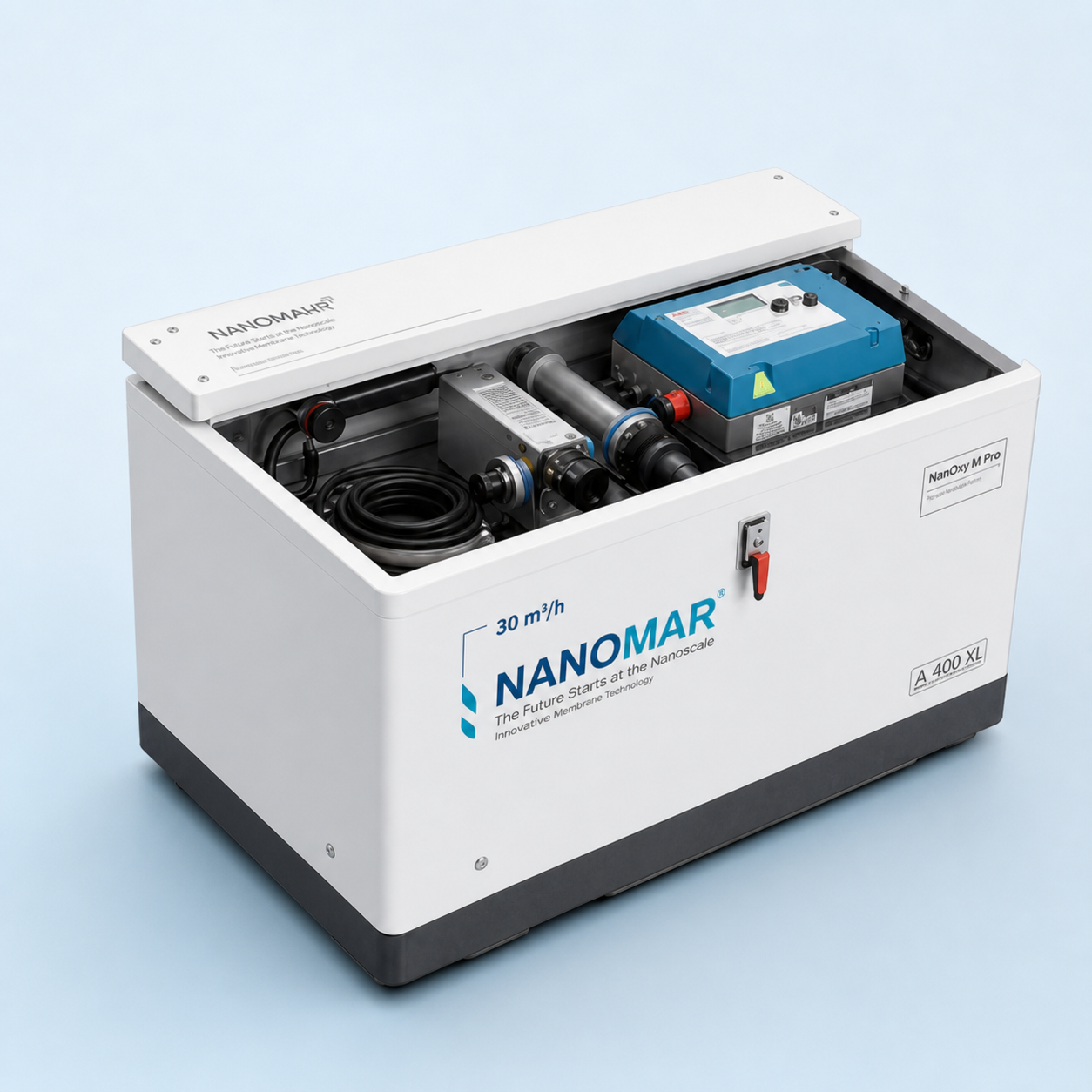
NanOxy M Pro
A compact pilot system with a nominal 35–55 m³/h flow, designed for process validation, pilot studies, scale-up planning and operational testing.
10–100 m³/h
At a glance
- Long lifespan
- Pilot scale
- Nominal duty 35–55 m³/h
- Reliable performance
Capacity and performance
A pilot machine has an awkward job: it has to be small enough to move and commission quickly, and large enough that what it measures still means something at production scale. The M Pro is sized for that overlap.
What a pilot has to prove
The physics of nanobubbles is not in question and does not need piloting. What needs piloting is the interaction between that physics and your water: how the generation stage behaves with your solids loading, what dissolved oxygen actually holds at your temperature and salinity, and whether the effect you are buying survives contact with your process.
A pilot that is not designed to answer a specific question produces an anecdote rather than defensible evidence, which is why an M Pro trial is run against a written pilot and measurement protocol. Before an M Pro is placed, we would rather agree three things with you: the parameters that will be measured, the instruments that will measure them, and the baseline period they will be measured against. A trial without a documented before cannot demonstrate an after.
The other reason to run a pilot is negative evidence, and it is the more valuable one. If your problem turns out to be something nanobubbles do not solve, a pilot is a cheap way to find that out — much cheaper than a production installation that under-delivers for reasons nobody characterised.
Technical specifications
The M Pro is a compact pilot system built for repeated deployment rather than a single trial. Long service life matters more here than on a fixed installation, because a pilot unit is moved, connected, disconnected and moved again.
Because it uses the same generation technology as the production nanobubble systems, results transfer. That is the point of the machine: a scale-up decision founded on a pilot with different physics is not founded on anything.
Gas options: O2, air, ozone
Test the gas you intend to buy. Piloting on oxygen and then specifying air is a common way to be surprised later.
Oxygen
Highest achievable dissolved concentration. The right pilot gas when the production duty is a biological load at density.
Air
No supply to arrange for the trial, and often enough for irrigation, ponds and lighter industrial duty. Lower ceiling on dissolved oxygen.
Ozone
For disinfection and biofilm trials rather than oxygenation. Reverts to oxygen, so the pilot leaves no residual behind in your process.
Typical applications
Where an M Pro earns its keep before a production system is specified.
| Situation | What the pilot settles |
|---|---|
| Scale-up from a bench trial | Whether an S2 result at 2–50 lpm still holds at 35–55 m³/h with real process water |
| An unusual or difficult water | How the generation stage copes with your solids, hardness and temperature over weeks rather than hours |
| A large capital commitment | The oxygen budget in practice, so the production unit is sized against measurement rather than assumption |
| A process nobody can stop | Whether the effect is achievable on a side stream without touching the main flow |
| An internal business case | A measured before and after on your own site, which is the only evidence a board tends to accept |
Installation and integration
A pilot should be quick to place and quick to remove. That constrains where it goes.
-
01
Find a pumped side stream
The unit takes a slipstream and returns it, so it can be valved out without stopping the process. On most sites this is the only practical connection point for a temporary installation.
-
02
Arrange the gas before the machine arrives
Oxygen or ozone supply is the item that most often delays a pilot. Air needs nothing, which is one reason air pilots start faster even when oxygen is the eventual answer.
-
03
Instrument the baseline first
Run the measurement plan for a period before the unit is switched on. Without that period there is nothing to compare against.
-
04
Run through a real cycle
A feeding cycle, a production week, a cleaning regime. A pilot that only sees the easy hours measures the easy hours.
-
05
Decide what production looks like
The pilot gives an oxygen budget at your conditions; that budget sizes the production system rather than a catalogue figure.
Energy use
Measure energy per kilogram of gas actually transferred, not motor rating — and measure it during the pilot, because this is the number that decides operating cost for the following decade and the pilot is your only chance to establish it on your own water.
NanoMAR publishes a 40 %+ improvement in oxygen transfer for nanobubble generation compared with conventional bubble aeration, and lower energy operation. We deliberately do not publish an energy-saving percentage, because an honest one depends on your alpha factor, temperature, tank geometry and the state of your existing diffusers. A pilot produces your figure rather than a generic one.
Note also that the pump is usually the dominant electrical load, which means the placement of the unit in the loop can affect the result as much as the unit itself. Worth recording where it was connected alongside the numbers.
Frequently asked questions
- What flow does the NanOxy M Pro handle?
The NanoMAR NanOxy M Pro covers 10–100 m³/h with a nominal duty of 35–55 m³/h. That range is chosen so pilot results transfer to a production specification rather than needing to be extrapolated.
- How is the M Pro different from the NanOxy S2?
The NanoMAR NanOxy S2 is a portable laboratory unit at 2–50 lpm for bench trials and repeatable R&D work. The M Pro is pilot scale at 10–100 m³/h, intended to validate a process on real site water before a production system is specified.
- Can a pilot unit be used in production afterwards?
The M Pro is built as a pilot platform with a long service life, and the production range starts where its duty ends. NanoMAR would normally specify a production unit — NanOxy Pro or NanVANN Pro — against what the pilot measured.
- What should be measured during a pilot?
Agree the parameters, instruments and baseline before installation. For a NanoMAR nanobubble pilot that usually means dissolved oxygen at defined points, turbidity or suspended solids, temperature, and the energy drawn per kilogram of gas transferred.
Download datasheet
Datasheets, like a firm price, are issued with a quotation rather than published, because the document that matters is the one written against your flow, your gas and your water chemistry — a generic sheet for a pilot machine tells you least of all.
Ask for it along with a sizing conversation and you will get the specification for your duty point instead of a range. Working the oxygen budget first gives you a defensible starting figure to send with the request.
Request a quote
Tell us the question you need answered and the conditions you need it answered under, and we will design the trial with you.
Specifications
| Flow range | 10–100 m³/h |
| Bubble size | < 200 nm |
| Gas options | Oxygen · Air · Ozone |
| Separation stages | Membrane · Venturi · Ceramic |
| Operation | Continuous, automated |
| Chemicals | None required |
Ready to rethink your water?
Tell us about your process and we'll size a nanobubble system for it.
Talk to our team