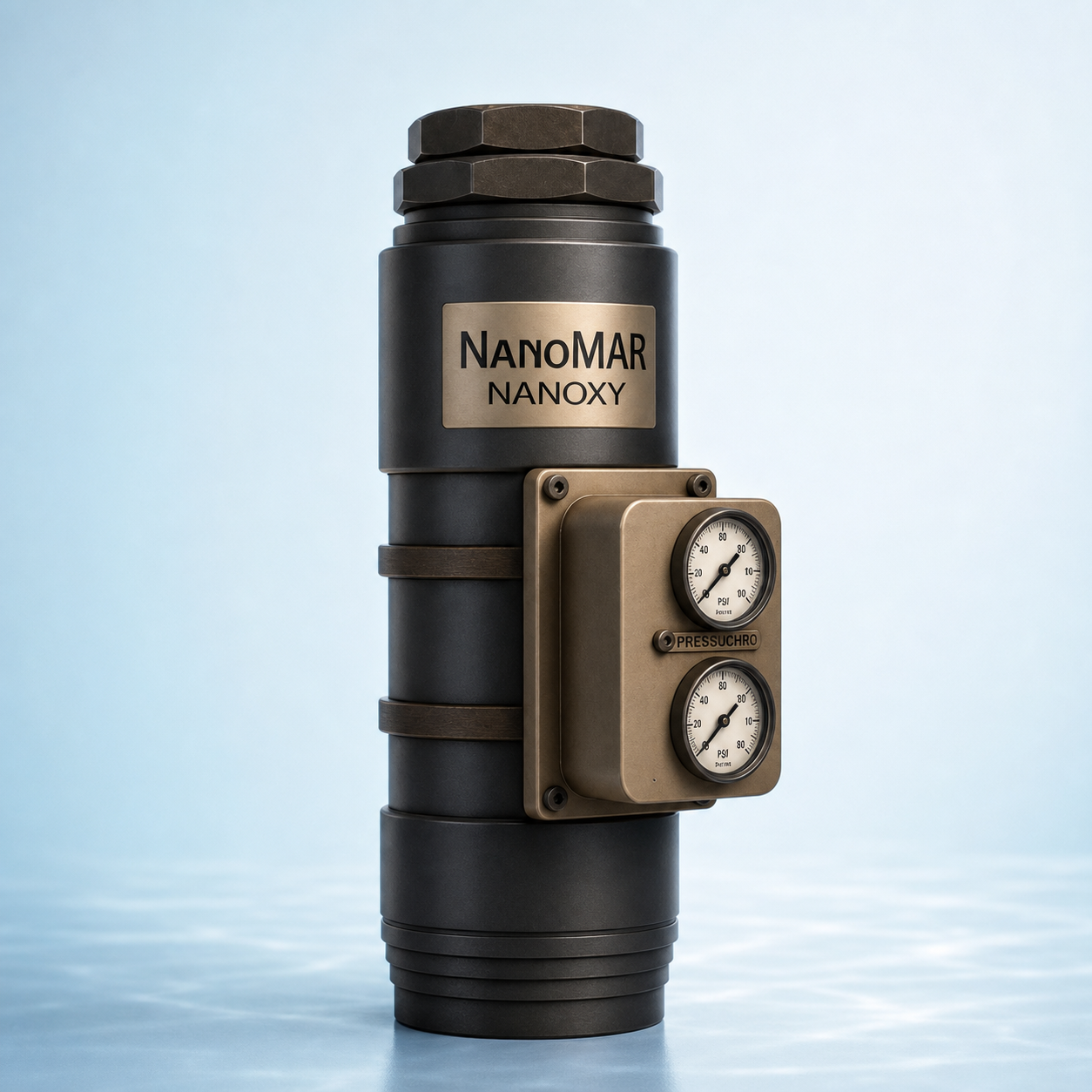
Nanobubbles are gas cavities under 200 nm, generated in process water and carried into a flotation or tailings circuit. At that size buoyancy no longer dominates, so they travel with the water rather than rising out of it, and persist for days. They nucleate on hydrophobic mineral surfaces, shortening induction time when flotation air arrives. In tailings water the same negative zeta potential lifts colloidal solids: NanoMAR publishes 80 %+ suspended-matter removal and 50 %+ turbidity reduction, with nothing dosed.
Nanobubbles attach to the fine mineral particles conventional bubbles pass by — the fraction that lacks the inertia to cross the streamlines around a rising bubble — and carry them into the froth. NanoMAR publishes no flotation recovery figure; that answer belongs to your ore, and it comes out of bench work and a side stream.
In tailings management they help clarify water for reuse, reducing fresh-water demand and the volume going to the pond.
Froth flotation and bubble size
Flotation is a collision problem: a particle has to meet a bubble, drain the film between them, and hold on to the froth. Collector, frother and hydrodynamics raise those odds.
The recovery-by-size curve punishes both ends. Coarse grains attach and are torn off in the turbulent zone; fines lack the inertia to cross the streamlines around a rising bubble.
What changes under 200 nm
Buoyant force scales with volume, drag roughly with radius, so under 200 nanometres buoyancy loses — the same physics in every industry. The cavity goes where the water goes and nucleates on hydrophobic surfaces, so a conditioned particle reaches the cell already carrying gas.
Which figures does NanoMAR publish?
Four, and no more — the platform, not a named mine or a named ore.
80 %+
Suspended-matter removal
Fines lifted by charged bubbles
50 %+
Turbidity reduction
On the treated stream
40 %+
Higher oxygen transfer
Against conventional aeration
Zero
Chemicals dosed
No flocculant, no residue
Mineral recovery
An overall recovery number hides where the metal goes. Size-fractionate the rougher tail and the loss usually sits in the finest material — the fraction the mill spent most power making.
Two mechanisms
Attachment: a cavity resting on a hydrophobic surface has drained part of the film before flotation air arrives, so induction time falls. Aggregation: gas bridging pulls hydrophobised fines into clusters that behave like coarser grains.
Clay colloids are the fines that refuse to settle. Turbid recycle costs twice: it dulls selectivity, and spends reagent bought for the ore on the water.
Coagulant and flocculant route
Nanobubble flotation
What is added
Polymer, coagulant, sometimes lime
Water and a gas only
Colloidal clays
Captured once conditioning is tuned
Drawn in by negative zeta potential
Return water
Residual polymer returns to the mill
Only what the water already held
Published removal
Depends on the dosing programme
80 %+ suspended matter · 50 %+ turbidity
A thickener stays a thickener; what changes is overflow clarity, and less liquid to dewater.
Reagent consumption
Reagents recur every hour the mill runs, landing in the consumables budget, the tailings chemistry and the discharge consent. Cleaner return water wastes less collector on chemistry the recycle brought back.
The limit matters more than the promise. Nanobubbles do not make a mineral hydrophobic, so an ore that needs a collector still needs one. The generator adds nothing — water and a gas, no residues, no chemical storage on site, the same position as nanobubble aeration in practice wherever dosing is replaced.
Where does the equipment go in the circuit?
In water, never in pulp: the generator charges water and the water carries the bubbles in, away from the abrasive path.
01
Conditioning ahead of the rougher
Charged water enters with the collector, so particles reach the cell carrying gas.
02
Thickener feed and return water
Bubbles lift the colloidal fraction flocculant struggles with; mill water starts cleaner.
03
Tailings storage
Gas held for days works on stratification, odour and algal growth.
Which NanoMAR unit fits a mining duty?
Bench testwork, then a side-stream pilot, then production equipment sized on the pilot.
Model
Flow
Role
NanOxy S2
2–50 lpm
Portable unit for bench flotation testwork
NanOxy M Pro
10–100 m³/h (nominal 35–55)
Side-stream pilot and scale-up planning
NanOxy S1
0.3–1 000 m³/h
Membrane platform to industrial flow; compressed gas required
NanVANN Pro
5–500 m³/h
Tailings and effluent duty: TSS and TOC reduction
The ceramic stage exists for abrasive, chemically aggressive water.
What should a mining pilot measure?
Against a baseline, on the sampling schedule you already keep.
Recovery by size fraction. An overall number cannot show whether the fines moved.
Grade at fixed recovery. Read the curve; mass pull flatters a careless comparison.
Reagent per tonne of concentrate. Normalise to product — head grade drift reads as a saving.
Turbidity and suspended solids. Thickener overflow and return water, at existing sample points.
Energy at the skid. Pump and generator, against the load displaced.
When are nanobubbles the wrong tool?
Three cases where we would spend the money elsewhere.
Liberation-limited losses
Value locked in coarse composites is a grinding problem. No bubble size changes mineralogy.
Metals in true solution
Dissolved metal is precipitation or ion-exchange duty, not a particle problem.
Sulphide-bearing water
Oxygen where sulphides sit can accelerate oxidation; argue gas choice from your water chemistry.
FAQ
How do nanobubbles improve froth flotation?
NanoMAR nanobubbles are gas cavities under 200 nm, too small for buoyancy to dominate, so they travel with the pulp and persist for days. They nucleate on hydrophobic mineral surfaces, shortening induction time, and bridge fines into clusters that float like coarser grains.
Do nanobubbles reduce reagent consumption?
A NanoMAR nanobubble stage doses nothing: the inputs are water and a gas, so no residue reaches the pulp or the tailings. Whether collector and flocculant additions come down is ore-specific, and NanoMAR publishes no reagent-saving percentage.
How do nanobubbles clarify tailings water?
Nanobubbles carry a strong negative zeta potential that attracts fine colloidal solids and lifts them from the water phase. NanoMAR publishes 80 %+ suspended-matter removal and 50 %+ turbidity reduction, with no coagulant or polymer dosed.
Which NanoMAR system suits a mining site?
NanoMAR runs bench testwork on the NanOxy S2 at 2–50 lpm, pilots on the NanOxy M Pro at 10–100 m³/h, and specifies production duty on the NanOxy S1, 0.3–1 000 m³/h. Tailings water is NanVANN Pro duty.
Send us your circuit data
Grind size, the size-fractionated rougher tail, reagent additions, overflow turbidity. Our Bergen engineers will tell you honestly whether a nanobubble stage suits your ore.