
All industries

Industries

Wastewater

Aeration that keeps more of the gas you buy in the water, and flotation that takes fine solids out of it.

Nanobubble aeration dissolves oxygen into wastewater as gas cavities under 200 nm. Bubbles that small are effectively neutrally buoyant, so they stay in the water for days instead of rising and venting at the surface, and gas transfer approaches completion. NanoMAR systems deliver 40 %+ higher oxygen transfer than conventional bubble aeration. The same bubbles carry a strong negative charge that lifts fine solids, giving 80 %+ suspended-matter removal and 50 %+ turbidity reduction. Nothing is dosed, so no coagulant or oxidant residue reaches the sludge or the discharge.

Wastewater

Aerobic treatment is limited by how much oxygen actually dissolves, not by how much air the blowers move. Coarse bubbles rise and vent within seconds; nanobubbles under 200 nm are effectively neutrally buoyant and keep transferring gas for days. NanoMAR publishes 40 %+ higher oxygen transfer and lower energy operation.

The same platform floats fine solids and organics out of the water phase — 80 %+ suspended-matter removal, 50 %+ turbidity reduction — so there is less liquid to dewater and less mass to handle downstream. NanoMAR publishes no energy-saving percentage: the honest figure depends on your tank geometry, temperature, alpha factor and diffuser condition. Compare systems on kilowatt-hours per kilogram of oxygen transferred.

The energy cost of aeration

Ask a plant manager where the electricity goes and the answer is the blowers. Biological treatment is an oxygen-delivery problem, and every kilowatt is spent forcing gas through water in the hope enough dissolves before the bubble surfaces.

Much of it does not. A coarse bubble leaves the diffuser a few millimetres across, buoyancy takes over, and it clears the column in seconds. What has not dissolved by then goes to the atmosphere.

Why the usual levers run out

More blower output buys more gas at the same poor efficiency. Fine-pore diffusers buy interface area, then foul. Deeper tanks buy contact time and cost civil works. Dissolved-oxygen control turns blowers down when the probe is satisfied; it cannot change how much blown gas reaches solution.

How nanobubbles change oxygen transfer

Take the bubble down three orders of magnitude and the physics inverts. Buoyant force scales with volume, drag roughly with radius. Below about 200 nanometres buoyancy loses, and the bubble goes where the water goes.

Two consequences follow. Contact time becomes days rather than seconds, so the bubble still transfers oxygen in the corner the diffuser grid never reached. And the gas–liquid interface becomes enormous — the quantity mass transfer is proportional to. Hence 40 %+ higher oxygen transfer.

Nanobubbles also carry a strong negative zeta potential, which draws in the fine and colloidal solids carrying much of the organic load. One pass oxygenates and destabilises — see how the platform works.

What figures does NanoMAR publish?

These four are the only performance figures. They describe the platform, not a named site.

40 %+
Higher oxygen transfer
Against conventional bubble aeration
80 %+
Suspended-matter removal
Fine solids lifted by charged bubbles
50 %+
Turbidity reduction
On the treated stream
Zero
Chemicals dosed
No coagulant, no polymer, no residue

Municipal treatment plants

A municipal plant is a fixed asset with a rising load: tankage sized for a smaller catchment, tighter consent limits, no capital for another lane.

Activated sludge aeration

What matters is not the reading at the probe but the distribution across the tank. A diffuser grid gives strong transfer above the headers and anoxic pockets at the ends, and that is where filamentous organisms win. Nanobubbles travel with the water, not upwards through it, so the profile flattens.

Where the unit goes

On a side stream, almost always: it can be valved out for service while the plant runs, and it is sized against the oxygen duty rather than the circulation rate. Holding oxygen in balance tanks and wet wells also prevents the sulphide chemistry plants answer with dosing — chemical-free water treatment at its plainest.

Industrial effluent

Industrial water is harder in one way: the load swings. A clean-in-place cycle can double the organic strength within the hour, and equipment sized on an average fails on the peak.

Food and beverage

Variable organic strength, plus fats and grease that blind conventional diffusers. Flotation and oxygenation in one pass suits batch discharges.

Oily and produced water

Dispersed hydrocarbon droplets are what a charged bubble attaches to, which avoids a demulsifier whose residue must be handled later.

Mining and minerals

Abrasive, chemically aggressive water that shortens the life of polymer components. The ceramic stage exists for it.

Disinfection duty

Where the duty is pathogen or biofilm control, the same generator runs on ozone and leaves no residue.

BOD and COD reduction

Separate the two: nanobubbles act on them by different routes, and a proposal folding both into one number hides which route it relies on.

BOD is what the biology can oxidise, and the rate is limited by oxygen at the floc. Holding dissolved oxygen throughout the tank, not at the probe, removes the starved fraction where residual load survives.

COD includes material the biology will not touch inside the retention time available. Part is particulate and leaves with the solids: charge-driven flotation at 80 %+ suspended-matter removal takes that fraction out physically. The soluble refractory remainder is an oxidation problem, and the argument for ozone.

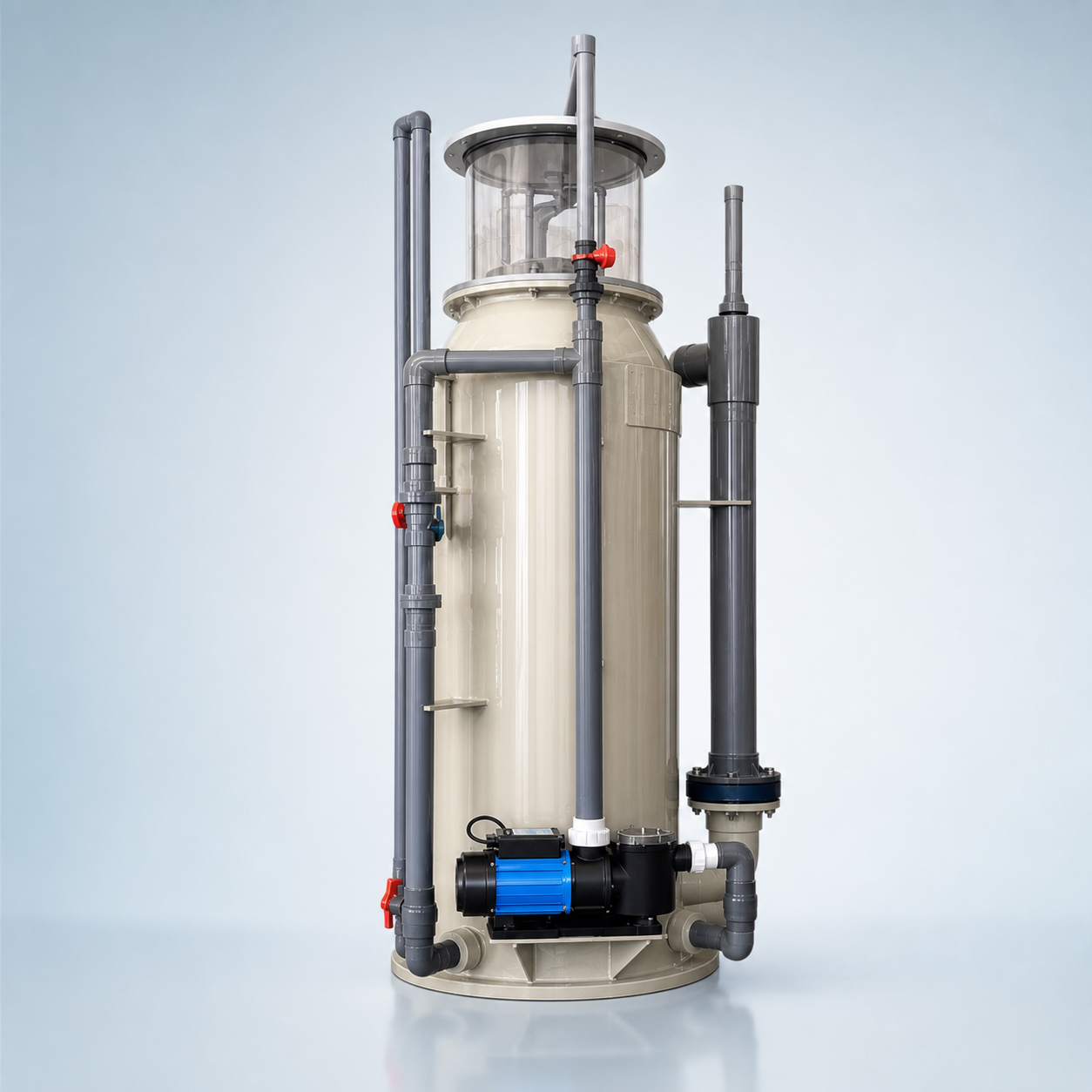
The NanVANN Pro is specified around those duties — TSS reduction, TOC reduction, TAN management — across 5–500 m³/h. Ammonia is nitrification-limited, and nitrifiers are the first population to suffer when the aerobic zone is patchy. The wider product range sits beneath.

Dissolved air flotation

DAF and nanobubble flotation are discussed as one process at two bubble sizes. They are not.

Conventional DAFNanobubble flotation
Bubble sizeTens of micrometresUnder 200 nm
How bubbles are madeRecycle stream saturated at pressure, then releasedGas sheared in at membrane, venturi or ceramic
AttachmentLargely entrapment in a rising cloudNegative zeta potential draws particles in
Conditioning chemicalsCoagulant and polymer dosing is normalNone
Colloidal solidsPoorly captured unless conditionedThe fraction targeted
Published removalDepends on the chemical programme80 %+ suspended matter · 50 %+ turbidity
Into the sludgeSolids plus everything dosed to catch themOnly what the water contained

Nanobubbles do not make a flotation cell unnecessary; they change what happens inside one. Existing DAF tankage is often the easiest retrofit.

Sludge handling

Sludge is where operating cost is quietly decided. It is aerated, stabilised, dewatered and hauled, and every step is billed by mass.

  1. 01

    No chemical mass added

    Coagulant and polymer become part of the cake and are paid for twice, at purchase and at disposal. A stage that doses nothing leaves only what the water held.

  2. 02

    Settleability upstream

    An evenly aerated basin is hostile to the filamentous organisms behind bulking. Sludge that settles thickens, and thickening is the cheapest volume reduction available.

  3. 03

    Aerobic digestion rate

    Digestion is oxygen-limited by definition. Held dissolved oxygen keeps it aerobic to the tank edges, which sets how long stabilisation runs.

  4. 04

    Septicity in storage

    Stored sludge turns anaerobic and generates sulphide. Oxygen held for days rather than seconds prevents the condition.

The energy maths

NanoMAR publishes no energy-saving percentage, and we would be sceptical of anyone who does: the honest figure depends on your alpha factor, temperature, tank geometry and diffuser condition. What the company publishes is the transfer figure — 40 %+ higher oxygen transfer — and lower energy operation.

Build the comparison in the one unit that makes two proposals comparable: kilowatt-hours per kilogram of oxygen actually transferred. Not motor rating. With nanobubbles the pump dominates, so weigh pump plus generator against blower plus grid.

  • Establish the real demand. Oxygen uptake rate at design load, plus nitrification demand and surface stripping losses.
  • Insist on field conditions. Clean-water tests flatter every aeration device ever sold; ask for efficiency at your temperature and solids.

That arithmetic is defensible in front of a board; a supplier percentage is not. Working the demand side comes first, and how a NanoMAR pilot is instrumented sets out the protocol we would use.

Which unit fits a wastewater duty?

A side-stream pilot first, then a production unit sized on what the pilot measured.

ModelFlowRole
NanVANN Pro5–500 m³/hFull wastewater duty: TSS, TOC, TAN
NanOxy M Pro10–100 m³/hSide-stream pilot and scale-up
NanOxy S10.3–1 000 m³/hMembrane platform to industrial scale
Before we quote for a treatment plant we ask for the oxygen uptake rate, not the tank volume. A plant that knows its real demand can compare two aeration systems honestly. One that knows only its blower rating buys on price.
Behnood Sjåstad Fathi Co-founder & CTO, NanoMAR AS

FAQ

What is nanobubble aeration in wastewater treatment?

Nanobubble aeration delivers oxygen, air or ozone into wastewater as bubbles under 200 nm. They are effectively neutrally buoyant, so they stay suspended for days instead of venting at the surface. NanoMAR generators shear them at a membrane, venturi or ceramic stage, and publish 40 %+ higher oxygen transfer.

Can nanobubbles cut aeration energy at an existing plant?

NanoMAR publishes no energy-saving percentage: the honest figure depends on tank geometry, temperature, alpha factor and diffuser condition. The published figures are 40 %+ higher oxygen transfer and lower energy operation. Compare suppliers on kilowatt-hours per kilogram transferred.

Does nanobubble treatment replace dissolved air flotation?

No — it changes what happens inside the flotation cell. Conventional DAF saturates a recycle stream under pressure and usually relies on coagulant and polymer. NanoMAR nanobubbles carry a negative zeta potential that attracts fine solids directly: 80 %+ suspended-matter removal, 50 %+ turbidity reduction, nothing dosed.

Is chemical-free wastewater treatment realistic?

Within the aeration and separation stage, yes. NanoMAR adds no chemical to the water: the only inputs to a nanobubble generator are water and a gas — oxygen, air or ozone. There are no by-products or residues, and the sludge holds only what the effluent held.

How does nanobubble aeration affect sludge treatment?

Nothing is dosed, so no chemical mass joins the cake. An evenly aerated basin discourages the filamentous bulking that stops sludge settling, and aerobic digestion is oxygen-limited, so held dissolved oxygen keeps stabilisation aerobic to the tank edges. NanoMAR specifies the NanVANN Pro for TSS and TOC reduction across 5–500 m³/h.

Send us your effluent data

Flow, BOD and COD, suspended solids, ammonia, and your consent limits. Our engineers in Bergen will work the oxygen budget with you.

Start the conversation

Ready to rethink your water?

Tell us about your process and we'll size a nanobubble system for it.

Talk to our team