Treating water with physics instead of additives is safer, cheaper over time, and better for the planet.
Conventional water treatment leans on a steady supply of chemicals — and everything that comes with them: storage, handling, dosing, by-products and discharge limits.
Nanobubbles take a different route. By dissolving oxygen or ozone with extreme efficiency, they oxygenate, disinfect and clarify water using physics, not additives. There is nothing to store, nothing to overdose, and no chemical residue to remove downstream.
For operators that means lower running costs and simpler compliance. For the environment it means cleaner effluent and a smaller footprint. It is a rare case where the more sustainable option is also the more practical one.
What do treatment chemicals actually cost?
Ask a plant what its chemicals cost and you get the invoice: so many tonnes of coagulant, so many drums of hypochlorite, a delivery schedule and a unit rate. That number is easy to find because it sits in one place. It is also the smallest part of the total.
Everything else a dosed process needs is spread across budgets nobody adds together — capital signed off years ago, labour that is simply part of the day. None of it surfaces when two routes are compared on reagent price alone, which is why that comparison flatters the chemical one.
The lines that never appear on the chemical invoice
Storage and containment. Bunded tanks, ventilation, segregation of incompatible stock, spill kit, and the floor area all of it occupies for the life of the plant.
Dosing plant. Metering pumps, injection quills, flow meters and the control loop behind them, plus calibration, spares and the re-tuning that follows every change in influent.
Sludge. Coagulants and precipitants do not disappear. Mass added upstream is mass to be dewatered, hauled and disposed of downstream, at a rate someone else sets.
Supply exposure. A reagent price is a commodity price, and shelf life bites too: hypochlorite loses strength in store, so the practical dose creeps up while the design dose stays in the manual.
Attention. Somebody orders, receives, decants, calibrates, logs and audits. That person is usually your most experienced operator.
None of this makes chemistry wrong. It makes chemistry a system rather than a line item, and the comparison is only honest when the whole system is on the page.
How does physics replace additives?
A nanobubble is a gas-filled cavity under 200 nanometres across, and at that size the behaviour every operator associates with bubbles stops applying. Buoyant force scales with volume; drag scales roughly with radius, so below 200 nm buoyancy loses the argument. The bubble goes wherever the water goes — for days to weeks, rather than the few seconds a coarse bubble survives at the surface.
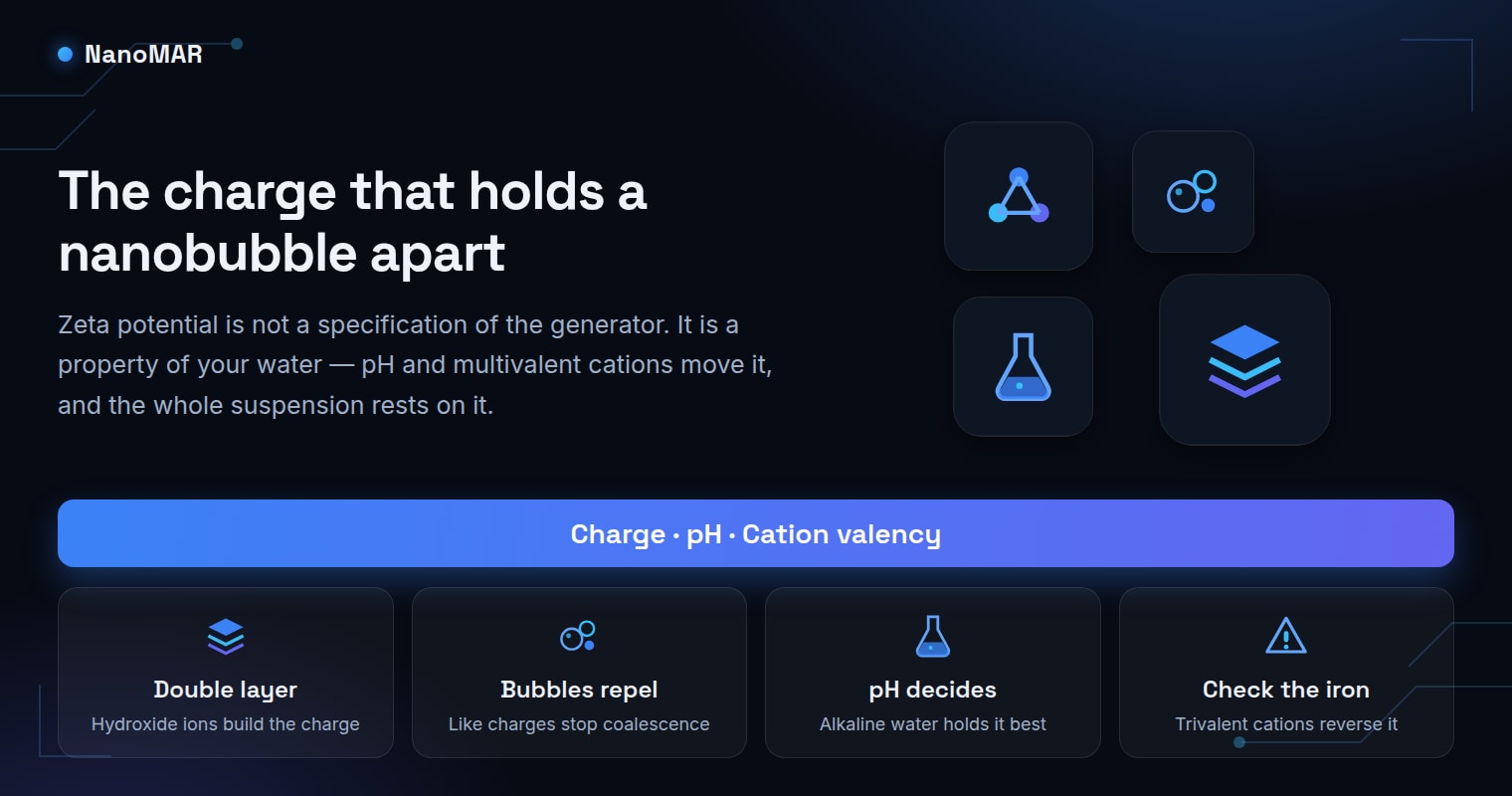
Two properties then do the work that two different chemicals were doing. The combined gas–liquid interface of a given volume of gas becomes enormous, so transfer approaches completion instead of leaking to the atmosphere. And the bubbles carry a strong negative zeta potential, which draws in fine and colloidal solids and lifts them — the job a coagulant is dosed to perform.
What matters commercially is what is absent. Oxygen, air or ozone is all that enters the water. Nothing is dosed, so there are no by-products and no residues to strip, neutralise, declare or explain to a regulator. The mechanism is set out in full on our technology page.
Be careful with the word replace. Physics substitutes for the gas-transfer duty and much of the solids-separation duty — though flotation only lifts solids, and something still has to skim or draw off the float. It substitutes for nothing that requires a chemical species to be added, and in a wastewater plant that is where most of the argument sits.
Which figures does NanoMAR actually publish?
These are the performance figures NanoMAR publishes. There are no others, and any number outside this list is somebody's estimate.
80 %+
Suspended-matter removal
Lifted by surface charge, not precipitated by a dose
50 %+
Turbidity reduction
No coagulant involved
40 %+
Oxygen-transfer increase
The mechanism behind the lower-energy claim
Zero
Chemicals added
Only oxygen, air or ozone
What do discharge limits and compliance actually require?
A discharge consent is a statement about what leaves your site. Every substance introduced upstream of that boundary becomes something you have to account for, and the accounting is rarely proportionate to the dose. A modest addition of oxidant can bring residual limits, reaction-product monitoring and a reporting line that outlives its reason.
Remove the dose and a category of paperwork goes with it: no reagent inventory to declare, no safety data sheet at the gate, no residual to hold below a threshold, no reaction product to look for. What remains is measurement of the parameters the consent is actually about — suspended solids, turbidity, oxygen demand, ammonia — measured on the water itself.
Simpler evidence, not less of it
Switching to a physical process does not lower the standard of proof; it changes what you are proving. A dosed process is documented by dosing records, residual analysis and by-product analysis. A nanobubble process is documented by continuous instrument records of the outcome — a shorter chain, but only if the baseline was captured first.
So we treat the measurement plan as part of the specification. NanoMAR has no publishable customer references yet; what a pilot measures and what the customer receives is set out on the measurement and reporting page, and reference projects will be published as they complete.
Where does chemical handling put people at risk?
Safety cases are written around the chemical store more often than around the process itself. These are the exposures that vanish when there is nothing to store — and the ones that take their place.
Delivery and decanting. The coupling is where people meet concentrated reagent. Every delivery is a manual operation done under time pressure from a driver who wants to leave.
Incompatible stock in one bund. An acid and a hypochlorite that meet — in a bund, a drain or a shared dosing line — generate chlorine gas. Segregation is a design decision that has to survive years of small changes.
Overdose through a failed loop. A stuck valve or a lying probe can dose at full rate for hours. The damage lands on the biology, the consent and sometimes the pipework, and it is discovered downstream.
Tank entry and cleaning. Sediment in a dosing tank eventually has to be removed, which turns a routine job into a confined-space job with a permit and a standby.
The standing training burden. Handling drills, spill response, protective equipment and refreshers are a programme, not a one-off, and they are audited whether or not the store was opened this month.
What replaces it is not hazard-free. A nanobubble skid brings compressed gas, a pressurised loop and, where ozone is used, off-gas destruction and ambient monitoring. Those hazards sit inside equipment you can isolate, not in a store refilled on schedule.
What does the ten-year maths look like?
Capital is a decision taken once. A dosed process is a decision taken again every month for a decade. NanoMAR publishes no prices and no payback periods, so nothing below is a figure — these are the lines that belong in your own ten-year model.
Cost line
Dosed process
Nanobubble process
Consumables
Reagent bought every month, indexed to a commodity price and rising with load
Gas supply where oxygen or ozone is used; nothing bought in when the unit runs on air
Storage
Bunded tanks, ventilation, segregation of incompatible stock, floor area
No reagent store — the skid footprint and its service access
Dosing and control
Metering pumps, quills, calibration, spares, re-tuning after every influent change
Generator, pump and gas train; no dose to set, drift or verify
Electricity
Blowers, mixing and dosing pumps at today's transfer efficiency
Pump-driven duty. NanoMAR states lower energy but publishes no percentage, so model it from your own operating point
Sludge
Grows with every kilogram dosed, then dewatered, hauled and disposed of
Nothing added upstream, so no dosed mass reports to the cake
The membrane, venturi or ceramic stage fouls with solids loading, and degrades quietly rather than alarming; your water sets the interval
Risk
Spill, overdose, supply interruption, price shock
Equipment downtime and gas supply; no spill or overdose pathway exists
No price, payback or saving appears above, because NanoMAR publishes none. Fill it in with your own numbers, and hold every supplier to the same discipline.
Where is chemistry still the right choice?
We build nanobubble systems and would still specify a dose in the situations below. On most sites the realistic outcome is not zero chemicals but far fewer, used where physics cannot reach.
pH and alkalinity
Gas infusion can push pH down with carbon dioxide. It cannot push it up and it cannot buffer. Raising pH or restoring alkalinity is a dose, and no bubble physics substitutes for it.
Dissolved species
Phosphorus, metals and hardness leave water as solids only when something is added to precipitate them. Nanobubble flotation then removes those solids, which makes this a division of labour rather than a replacement.
A required residual
Where a consent requires a measurable residual disinfectant downstream of the plant, a physical process cannot provide one. Ozone nanobubbles act inside the vessel and revert to oxygen — the point of them, and also their limit.
Shock response
A biological upset or a pathogen event sometimes needs a step change within the hour. Equipment sized for steady duty is the wrong tool for a one-off intervention.
Small or rare duties
A tank treated a handful of times a year does not justify a skid, a gas supply and a maintenance regime. Sizing honesty cuts both ways.
Chemical-free water treatment achieves oxygenation, disinfection or clarification through physical mechanisms instead of dosed reagents. NanoMAR does it with nanobubbles: gas cavities under 200 nm generated from oxygen, air or ozone, which transfer gas almost completely and carry a negative zeta potential that lifts fine solids out of suspension. Nothing is dosed, so there are no by-products and no residues to remove downstream.
Can wastewater really be treated without chemicals?
A large part of the duty can. NanoMAR publishes 80 %+ suspended-matter removal, 50 %+ turbidity reduction and a 40 %+ increase in oxygen transfer for its nanobubble systems, and the NanVANN Pro wastewater unit covers 5–500 m³/h for TSS and TOC reduction and TAN management. Duties that need a chemical species added — pH correction, phosphorus precipitation, metals removal — still require a dose.
Do nanobubbles leave any residue in the water?
No. A NanoMAR nanobubble system introduces only oxygen, air or ozone, and ozone reverts to oxygen, so no chemical residue is created and nothing has to be neutralised or stripped afterwards. There is no reaction product to monitor and no reagent inventory to declare.
Is chemical-free water treatment cheaper than dosing?
NanoMAR publishes no prices and no payback periods, so we will not claim a saving. What changes is which cost lines exist: reagent purchase, chemical storage, dosing plant, sludge volume and residual analysis fall away, while capital, gas supply and equipment maintenance appear. Model those lines over ten years with your own contract rates and the comparison becomes specific to your plant.
Does treating water without chemicals use less energy?
NanoMAR states that nanobubble treatment operates at lower energy and deliberately publishes no percentage, because the honest figure depends on your temperature, your loop and your duty point. The published figure is a 40 %+ increase in oxygen transfer, which is the mechanism behind the lower-energy claim. Ask any supplier for energy per kilogram of gas transferred at your conditions, not motor rating.
What to measure before you change anything
Take the baseline. A trial without agreed numbers from before it started cannot be argued either way, which is a worse outcome than a trial that fails.
A baseline over a full cycle. Same instruments, same sampling points, at least one complete production or seasonal cycle before anything is installed. Agree it in writing with whoever will read the result.
Dissolved oxygen at the worst point. Not the probe that is easiest to reach. The value that matters is the far corner of the tank at peak load and peak temperature.
Suspended solids and turbidity as a pair. Turbidity moves quickly and tells you what is happening now; TSS is the mass the consent is written against.
Reagent use per cubic metre treated. Taken from the store, not from the design dose. The gap between the two is often the most interesting number on site.
Sludge leaving site, weighed dry. Dry solids mass and haulage frequency. This is where an upstream dose shows up as a downstream cost, and it is the slowest line to respond.
Sub-metered energy on the loop. Blowers, dosing pumps and circulation metered separately from the rest of the plant, so the comparison afterwards is arithmetic, not argument.