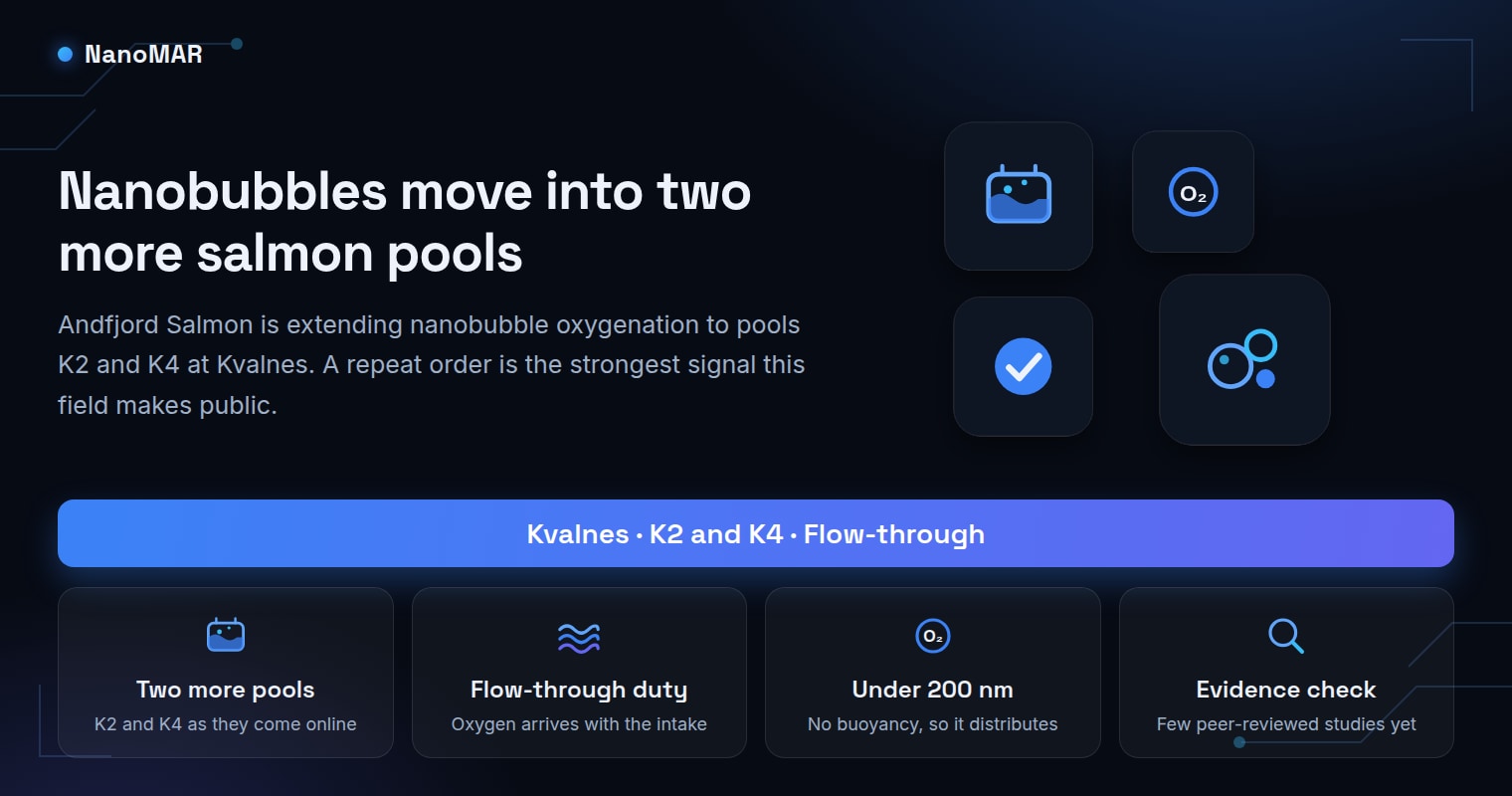
Andfjord Salmon will put nanobubble oxygenation into two more production pools at its land-based salmon farm at Kvalnes on Andøya in northern Norway. Supplier Moleaer announced the extension on 21 October 2026: generators already run in pools K1 and K3 and will go into K2 and K4 as those pools come online. The reason given is operating experience from the current cycle. No performance figures came with it.
Which pools are getting the technology, and when?
K1 and K3 carry the generators now, built into pool infrastructure supplied by Cflow. K2 and K4 follow as they enter operation, with no commissioning date given. Cflow's project manager Kjetil Osborg put the engineering point plainly:
Good water quality is achieved through the overall system design.
Andfjord Salmon's first-quarter report of 28 May 2026 gives survival of 99.17 and 99.24 per cent in the two operating post-smolt pools and a standing biomass of 1,584 tonnes. Unpublished is what an engineer wants: oxygen consumption, energy draw, and how a pool behaves at peak biomass rather than at stocking.
Why would a flow-through farm need nanobubble oxygenation at all?
Because replacing water is not the same as controlling the oxygen in it. A flow-through pool takes its oxygen in with the seawater, so the question is how much must be added on top, and whether it reaches the bottom as well as the top. A gas cavity under 200 nm has effectively no buoyancy, stays suspended for days to weeks, and distributes rather than rises.
A deep intake helps for a second reason that rarely makes the trade press: nanobubble aeration loses efficiency where the suspended-solids load is heavy, a limit the FAO's brief on the technology records from the published work. Water screened from depth is close to the best case. A recirculating loop is not.
| Oxygenation duty | RAS loop | Flow-through pool |
|---|---|---|
| Solids at the dosing point | High and variable, cutting transfer efficiency | Low, if the intake is deep and screened |
| Competing duties | CO₂ stripping, ammonia, biofilter stability | Mainly oxygen and temperature |
| If the generator stops | Oxygen falls quickly at density | Incoming flow buys a little time |
Is a repeat order actually evidence?
Commercially, yes. Scientifically, no, and the difference matters. The FAO's 2022 brief on the technology is blunt: studies of these devices are "still too few", while the anecdotal evidence of their value is compelling. It records suppliers' claims of better than 90 per cent transfer efficiency and says several manufacturer claims need independent verification. A farm that has run a cycle and buys again is the strongest signal this field makes public. That says something about the technology, and as much about the evidence.
The same brief warns buyers that much equipment sold as a nanobubble generator in fact produces microbubbles, which behave differently in water. For disclosure: NanoMAR builds nanobubble systems for aquaculture and RAS and competes with Moleaer, hence a comparison page.
What would I check before copying this design?
- Measured bubble size, not a brochure claim. Under 200 nm is the definition, not a feature. Ask for a size distribution.
- Behaviour at peak biomass. A pool that oxygenates comfortably with young smolt is a different problem at harvest weight.
- Which gas, and why. Ozone on an intake is a biosecurity decision, not an oxygen one.
NanoMAR's own published figure is 40 %+ higher oxygen transfer, nothing dosed and no residues. Which target values a farm holds is a separate argument.
Frequently asked questions
What did Andfjord Salmon announce about nanobubble oxygenation?
Andfjord Salmon is extending nanobubble oxygenation from pools K1 and K3 to K2 and K4 at its land-based salmon farm at Kvalnes on Andøya, Norway. Supplier Moleaer announced it on 21 October 2026, citing operating experience from the current cycle. No oxygen or energy figures were published.
How does nanobubble oxygenation work in a flow-through fish farm?
In a flow-through farm, oxygen arrives with the seawater and a nanobubble system adds what the biomass needs. A nanobubble measures under 200 nm, so it has effectively no buoyancy and stays suspended for days to weeks, spreading oxygen through the water column rather than near the surface.
Is nanobubble oxygenation proven in salmon farming?
Only partly. The FAO's 2022 brief on nanobubble technology in aquaculture says peer-reviewed studies remain too few to verify manufacturers' claims, while operator experience is positive. A repeat order from a working farm, such as Andfjord Salmon's at Kvalnes, is commercial evidence rather than measurement.
My own reading has little to do with whose generator it is. It is about where it sits. Most of my work has been RAS water quality and design optimisation on recirculating systems, and the habit I had to unlearn was treating an oxygen budget as a number. It is a map. I used to size against the pool average. Then you stand on a walkway with two probes a few metres apart, same depth, reading differently. The average stops being interesting.
If you are sizing oxygenation for a land-based pool or a recirculating loop, send the duty and an intake analysis and we can work through what a nanobubble stage would have to prove.
Sources
- Andfjord Salmon Extends Partnership with Moleaer — Moleaer
- Andfjord Salmon Q1 2026 results and operational update — Andfjord Salmon
- Sustainable intensification of aquaculture using efficient nanobubble technology — FAO, 2022
- More nanobubbles for Andfjord Salmon — The Fish Site