Andfjord Salmon extends nanobubble oxygenation to two more pools
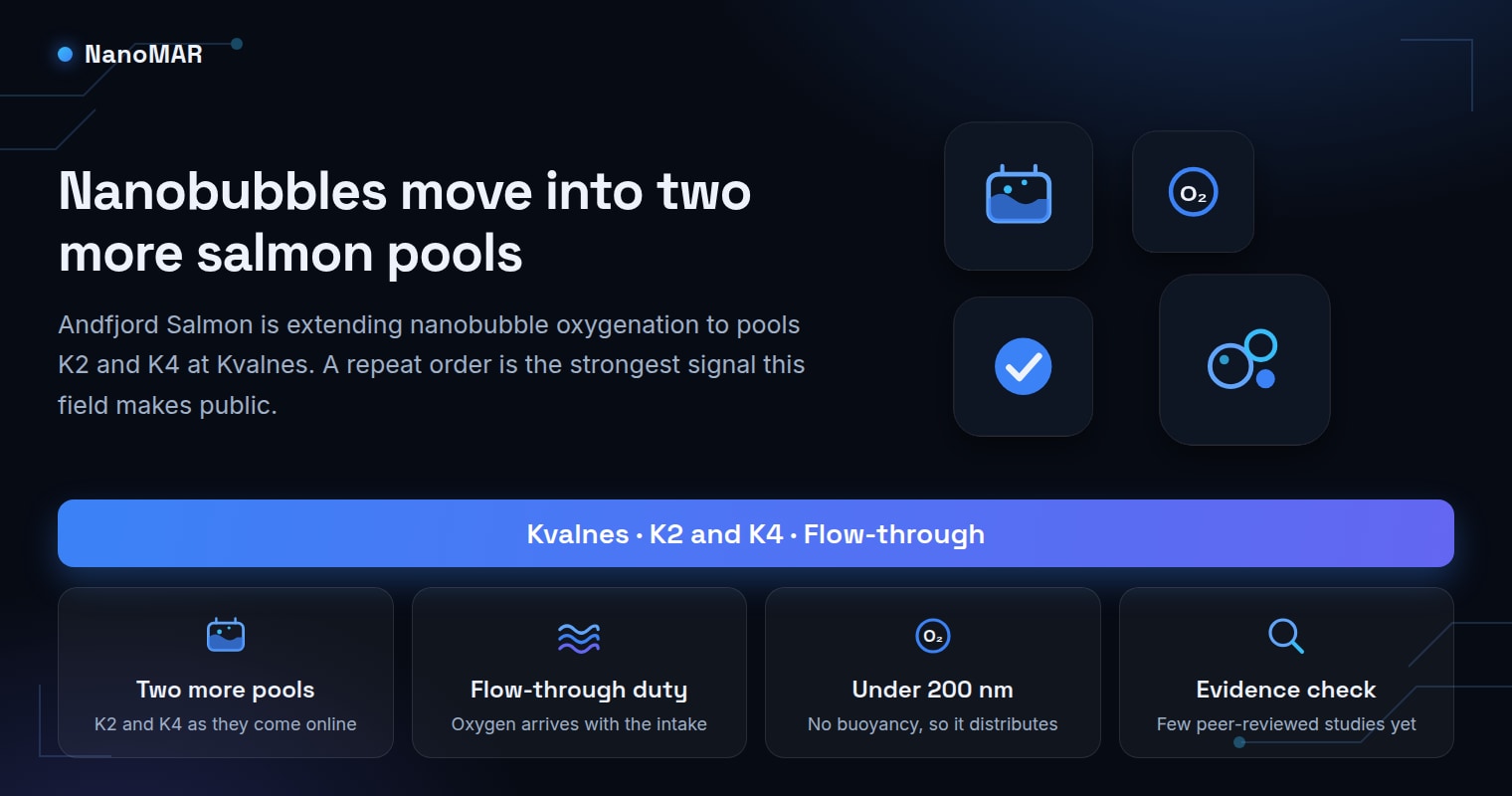
Andfjord Salmon is extending nanobubble oxygenation to pools K2 and K4 at Kvalnes. What the announcement says, what it leaves out, and what it proves.
Read articleBlog
Notes on nanobubble technology, aquaculture and chemical-free water treatment.
Andfjord Salmon is extending nanobubble oxygenation to pools K2 and K4 at Kvalnes. What the announcement says, what it leaves out, and what it proves.
Read articleZeta potential is the negative charge that keeps nanobubbles apart. What it does to suspended solids, what weakens it, and how to measure it properly.
Read articleDet finnes ikke én kritisk oksygengrense for fiskehelse, men flere. Slik skiller forskningen mellom overlevelse, appetitt og immunrespons.
Read articlePrisen på et RAS-anlegg styres av vannmengde, dose, gasskilde og plassering i loopen. Her er driverne bak kostnaden for oksygenering.
Read articleEt settefiskanlegg er fire vannbehandlingsoppgaver i samme rørsystem. Slik endrer vannbehovet seg fra klekkeri til smolt — fase for fase.
Read articleMicrobubbles rise and burst in seconds. Nanobubbles under 200 nm stay suspended for days to weeks. Where the size boundary sits, and what it decides.
Read articleUnder trenging svikter oksygenet først, og pumping kan gi gassovermetning. Slik følger du vannkvaliteten før, under og sju døgn etter en avlusing.
Read articleUV inaktiverer, men fjerner ingenting og gir ingen restvirkning. Slik henger dose, turbiditet og UV-transmisjon sammen — og hvor forbehandling hører hjemme.
Read articleNanoMAR's co-founder, a marine biologist and water-purification researcher at the University of Bergen, has died. Behnood Sjåstad Fathi on ten years of working beside him.
Read articleTre av effektene har et publisert tall: 40 %+ oksygenoverføring, 80 %+ suspendert stoff, 50 %+ turbiditet. Her er mekanismen bak hver — og hva du må måle selv.
Read articleForskriften gir funksjonskrav, ikke en tabell med grenseverdier. Slik setter du målverdier og alarmgrenser for oksygen, TAN, nitritt og CO₂ i landbasert oppdrett.
Read articleMekanisk filtrering, biologisk rensing, avgassing, desinfeksjon og oksygenering: hva hvert trinn i et oppdrettsanlegg sender videre til det neste.
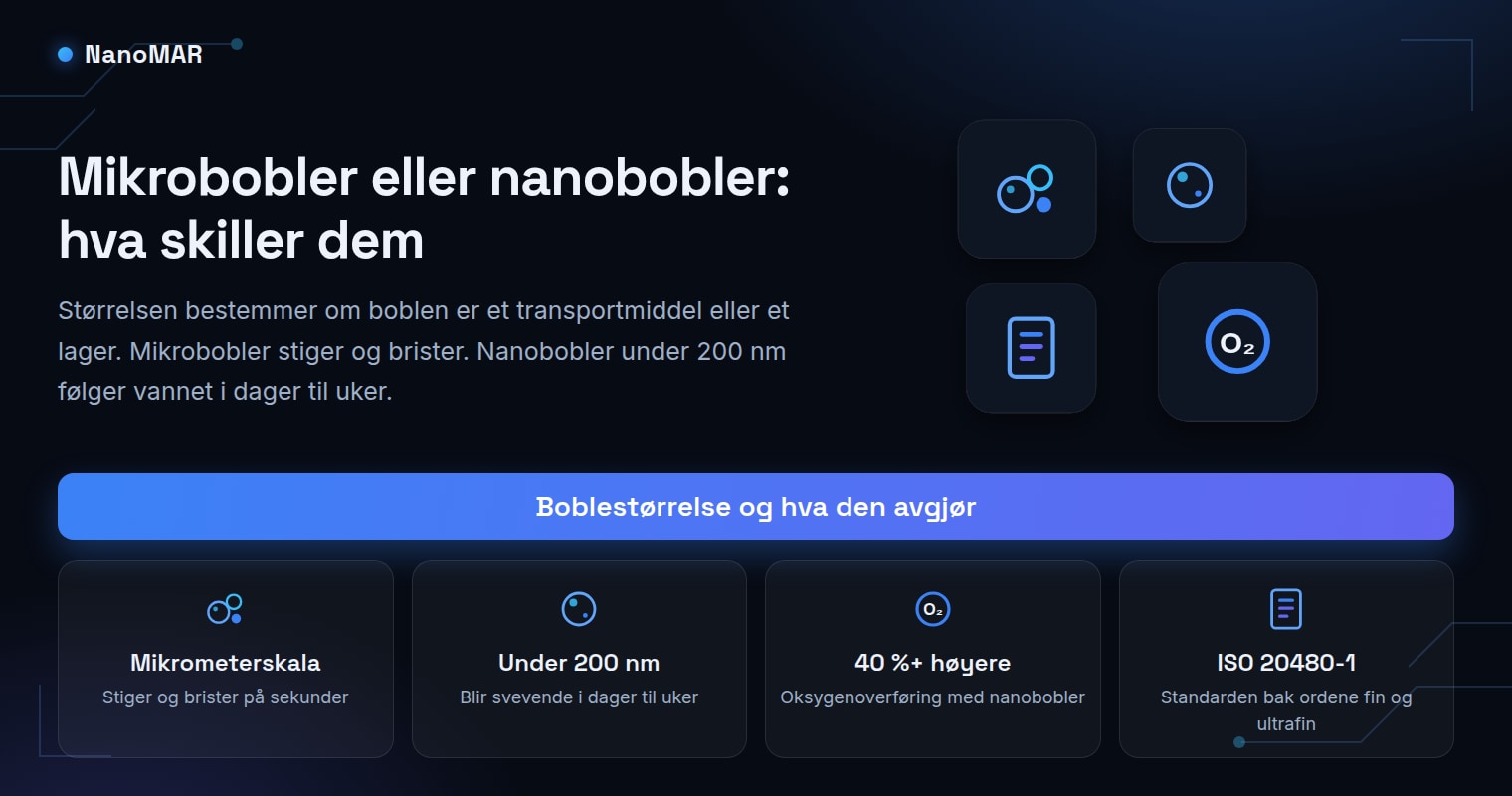
Read articleMikrobobler stiger og brister på sekunder. Nanobobler under 200 nm blir svevende i dager til uker. Her er skillet, og når hver type passer.
Read articleKjemikaliefri vannrensing erstatter dosering som flytter partikler eller gass. pH, alkalitet og felling blir stående. Her er skillet.
Read articleValget av renseanlegg avgjøres av vannet, utslippskravet og hvem som drifter det. Slik rangerer du kriteriene før du sammenligner leverandører.
Read articleNanobobler forblir svevende fordi oppdriften taper mot vannmotstand og Brownske støt — og fordi overflateladningen hindrer at boblene slår seg sammen.
Read articleEt RAS-anlegg er tre regnskap som må gå opp samtidig. Slik henger komponentene, oksygenbudsjettet, biofilteret og CO₂-avgassingen sammen i praksis.
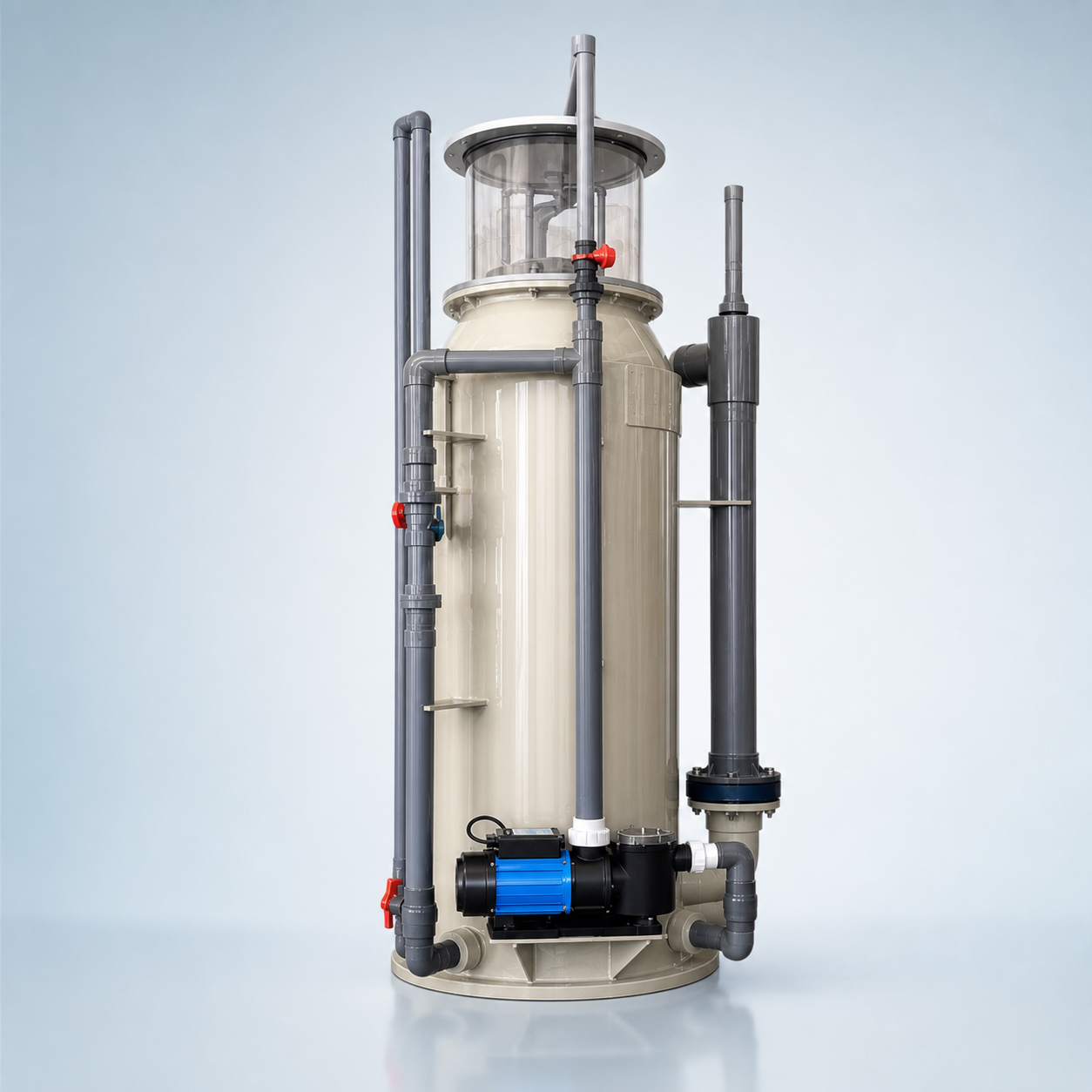
Read articleFlow, dose and duty decide which nanobubble generator fits. How to size one, what separates the five NanOxy models, and what really drives the cost.
Read articleNanobubbles do three jobs in water: transfer gas, lift particles, keep surfaces clean. How that plays out in RAS, wastewater, greenhouses and mining.
Read articleNanobubbles are generated by forcing gas into water through a membrane, a venturi or a ceramic element. Here is how each method behaves in practice.
Read articleTreating water with physics instead of additives is safer, cheaper over time, and better for the planet.
Read articleFrom stable dissolved oxygen to lower disease pressure, nanobubbles are reshaping land-based fish farming.
Read articleSub-200 nm gas bubbles behave nothing like ordinary bubbles — here is what makes them so effective for water.
Read articleNo articles match your search.
Written in Bergen by the engineers who build the equipment, for people who own a water problem and have to defend a decision.
Start with what a nanobubble actually is: a gas cavity under 200 nm, effectively neutrally buoyant, suspended for days to weeks, carrying a strong negative zeta potential. Then the technology behind the platform, or how a generator is built when the open question is hardware: membrane, venturi or ceramic.
The aquaculture writing assumes a recirculating system: a biofilter you cannot upset, rising stocking density, a dissolved-oxygen reading that differs at every wall of the tank. The article on nanobubbles in aquaculture takes five claims in turn — oxygen stability, disease pressure under ozone, feed conversion, biofilm, energy — and gives the failure mode of each, not only the mechanism. Pair it with the aquaculture page once you move from deciding to sizing.
Partly. The useful half of that answer is our article on chemical-free water treatment, which costs a dosed process properly — storage, dosing plant, labour, sludge — then names the duties where we would still specify chemistry. The measurable half is flotation. NanoMAR publishes 80 %+ suspended-matter removal and 50 %+ turbidity reduction, with nothing dosed and no by-products left behind. Plant view: wastewater.
The same platform reaches 9+ industries, so these articles are organised by mechanism rather than sector. Match the problem, not the label.
| Problem | Mechanism | Where to read |
|---|---|---|
| Uneven dissolved oxygen | Oxygen transfer, 40 %+ higher | What are nanobubbles |
| Biofilm and cleaning downtime | Ozone nanobubbles, no residue | Chemical-free water treatment |
| Solids and turbidity in discharge | Flotation on negative surface charge | Chemical-free water treatment |
| Chemical storage and handling | Taking the dosing plant out | Chemical-free water treatment |
| Which machine, which flow | Generation method and sizing | Nanobubble generator page |
Three articles today; we publish when there is something worth saying.
NanoMAR AS was founded in 2023 by Prof. Thorolf Magnesen, whose water-purification research at the University of Bergen underpins the platform, and Behnood Sjåstad Fathi, a water-quality engineer with 6+ years on international aquaculture water-treatment projects.
No customer, site or country appears in any article; none are public yet. Energy is described qualitatively — lower, with no percentage published. More about the team.
The NanoMAR blog covers nanobubble technology, aquaculture and RAS, wastewater without dosing, and industrial process water. It is written by the NanoMAR team in Bergen. Three articles are published: what nanobubbles are, nanobubbles in aquaculture, and chemical-free water treatment.
Every performance figure in a NanoMAR article is a published NanoMAR specification: 80 %+ suspended-matter removal, 50 %+ turbidity reduction and 40 %+ higher oxygen transfer. Figures are quoted as published, never recombined. Where no measured number exists, such as energy, the article says so.
Not yet. NanoMAR has no publishable customer references, so no article names a customer or a site. The proof and verification page sets out how a pilot runs and what gets measured; reference projects will be published as they complete.
Start with the NanoMAR article on what nanobubbles are: a gas-filled cavity under 200 nm that stays suspended for days to weeks and carries a negative zeta potential. It explains the mechanism before any equipment.