From stable dissolved oxygen to lower disease pressure, nanobubbles are reshaping land-based fish farming.
Land-based and recirculating aquaculture systems live or die by water quality. Here is where nanobubbles make the biggest difference:
1. Stable dissolved oxygen across the entire tank, not just near the diffuser.
2. Lower disease pressure thanks to ozone nanobubbles that reduce pathogens without residue.
3. Reduced water exchange, saving energy and heat.
4. Better feed conversion and growth from consistently oxygenated water.
5. Fewer chemicals, for healthier fish and a cleaner discharge.
Together these gains improve welfare, survival and margins — which is why nanobubble oxygenation is becoming standard in modern RAS.
1. Stable dissolved oxygen: can you hold it across the whole tank?
The problem on a land-based farm is rarely that dissolved oxygen is too low. It is that it is different everywhere. A probe near the inlet reads one thing, a probe at the far wall reads another, and the fish arrange themselves according to the reading nobody has.
That gradient belongs to coarse bubbles, not to the tank. Gas from a diffuser rises by the shortest route to the surface, and whatever has not dissolved on the way leaves as off-gas. Transfer happens in a plume; the rest of the tank gets whatever the flow pattern mixes in.
Nanobubbles change the geometry of the problem. A gas cavity under 200 nm is effectively neutrally buoyant — it travels with the water instead of rising out of it, and stays in suspension for days to weeks. Water leaving the generator carries a reservoir of gas rather than a burst of it, and keeps transferring downstream: along the pipe, into the tank, around the far wall. NanoMAR publishes 40 %+ higher oxygen transfer on that mechanism.
Two operating rules follow. Measure where the fish are, never in the injection plume. And size against the worst hour — the peak after feeding, in the warmest week — because a system sized on a daily average runs short exactly when demand is highest. Where the unit belongs in a recirculating loop is set out on our aquaculture water treatment page.
2. Lower disease pressure: what do ozone nanobubbles actually do?
Ozone is long established in hatcheries and land-based farms, so the useful question is not whether it works but where it ends up. Dosed as coarse bubbles into a contact tank, much of it leaves through the surface before meeting anything worth oxidising. Sheared to under 200 nm, the same dose stays in the water column across an enormous combined gas–liquid interface.
The second mechanism is mechanical, and the one people underestimate. Nanobubbles carry a strong negative zeta potential, so fine particles attach to that charged surface and are lifted; it is the same effect the platform is used for in flotation duties. NanoMAR publishes 80 %+ suspended-matter removal and 50 %+ turbidity reduction. On a farm those are biosecurity figures rather than cosmetic ones: fine solids are surface area, surface area is where bacteria live, and every reuse pass concentrates both.
The part that belongs in any honest article
Ozone is a designed stage, not a switch. It needs a contact volume, a residual destroyed or stripped before the water reaches fish or biofilter media, and instrumentation you trust — ozone arriving at a moving bed will damage the nitrifying population you matured at start-up. It is no substitute for mechanical filtration either; it oxidises what the drum filter left behind. Treating water before it reaches the tank is a separate discipline, written up on our intake water and biosecurity page.
3. Better feed conversion: is there a number behind it?
NanoMAR publishes no feed conversion figure, and you should be sceptical of any supplier who quotes one without describing the trial that produced it. Feed conversion is the slowest and noisiest indicator on a farm. It moves with temperature, feed batch, size class, grading events, mortality accounting and how closely the feed table is followed.
The mechanism is nevertheless straightforward. Digestion and growth are aerobic. When dissolved oxygen falls below what a size class needs, appetite drops first, then feed goes uneaten, then that uneaten feed becomes organic load for a biofilter that is already working. An oxygen sag is paid for twice: once in growth, once in water quality. Holding oxygen through the post-feeding peak removes the sag instead of compensating for it afterwards.
If you want a defensible number from your own water, the trial has to be built for it — parallel tanks of the same size class and origin, the same feed batch and feed table, an agreed baseline before anything is installed, and enough weeks to cover a grading cycle. Anything shorter measures the weather.
4. Less biofilm in pipes and tanks: where does fouling actually slow down?
Biofilm is not one problem but four, in four places, with four different consequences. Nanobubbles reach all four for the same reason they hold oxygen across a tank: they travel with the water, and their negative charge lifts the fine particles that seed a film.
Transfer pipework and sumps
Dark, wet and continuously fed. Treated water carrying persistent bubbles keeps working along the whole run; a diffuser plume in one tank cannot.
Biofilter media
Heterotrophic growth competes with the nitrifiers for space and oxygen. The lever is removing fine organics upstream, not oxidising them at the media.
Probes and sensors
A fouled probe reads low, the control system adds gas nothing needed, and the fault surfaces as an energy problem. Cleaner water lengthens the calibration interval.
Exchangers and UV sleeves
Fouled surfaces cost money quietly. Heat transfer falls off, and dose falls behind a coated UV sleeve long before an alarm notices.
5. Lower energy use: where does the saving actually come from?
NanoMAR publishes no energy percentage, and inventing one would be worthless. What can be stated is where the saving comes from — three separate places, only one of which is the machine.
The gas you buy. At 40 %+ higher oxygen transfer, less of the oxygen you paid for leaves through the tank surface. On a farm running pure oxygen that is the line which responds first, and the easiest one to verify from your own gas records.
The pumping. Compare suppliers on energy per kilogram of gas actually transferred, never on motor rating: a unit that draws less power while venting more of its gas is the more expensive machine to run. Placement matters as much as specification — a side stream treats a slipstream at high concentration rather than the whole circulation at low, and can be valved out for service without stopping the farm.
The heat. In a tempered land-based system, every cubic metre of make-up water must be brought to temperature. Where better oxygenation and solids removal let a farm hold quality at a lower exchange rate, the saving lands on the heating bill rather than the generator's own meter — which is why it is so often missed.
The failure mode here is not technical: nobody recorded a baseline. Meter the oxygen supply, the circulation pumps and the heating separately for a few weeks before anything is installed. The demand side is what our calculator covers.
Measured results: which figures does NanoMAR actually publish?
Four figures, and only four. They are what NanoMAR publishes about the technology. None is attributed to a customer, site or species, because no reference installations are public yet.
40 %+
Higher oxygen transfer
The figure that governs an aquaculture duty
80 %+
Suspended-matter removal
Fine solids lifted by bubble surface charge
50 %+
Turbidity reduction
What that solids removal looks like on a meter
Zero
Chemicals dosed
No by-products and no residues to remove
Recommended system: which NanoMAR unit fits a fish farm?
Five models exist across the range. On a land-based farm the choice is normally between three of them, driven by flow and by the stage the project has reached — not by tank count.
Model
Flow
Where it fits on a farm
NanOxy Pro
18.9–75.6 m³/h
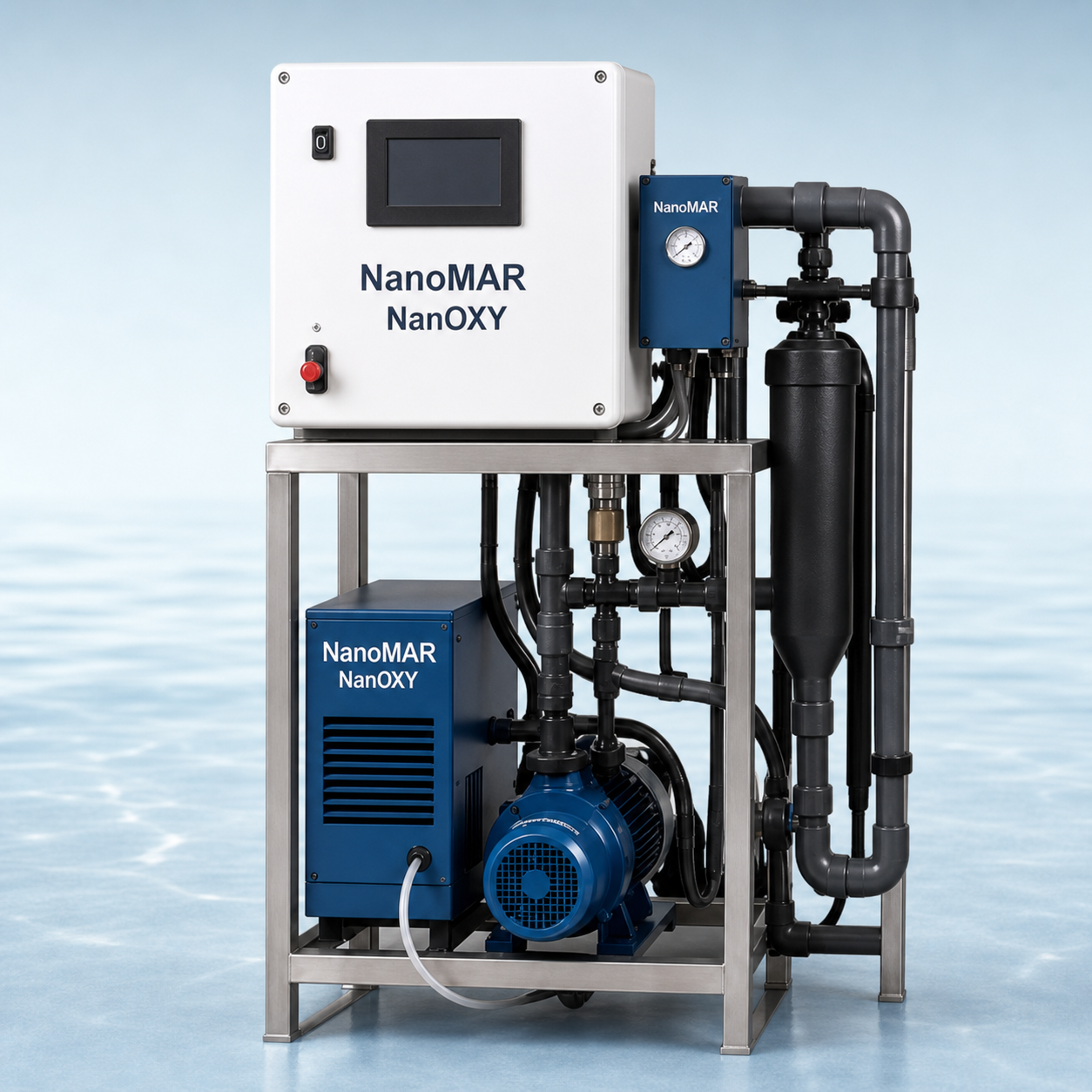
Skid-mounted continuous duty: 18.9 m³/h at 40 mg/L, 37.8 m³/h at 20 mg/L, 75.6 m³/h at 10 mg/L. Approximately 200 kg
NanOxy M Pro
10–100 m³/h (nominal 35–55)
Compact pilot platform for process validation and scale-up planning before a full installation is committed
NanOxy S1
0.3–1 000 m³/h
Membrane platform from laboratory research to full industrial scale. Compressed gas required; no electrical connection at the membrane module
NanOxy S2
2–50 lpm
Portable membrane unit for oxygenation trials and repeatable R&D validation on a bench
NanVANN Pro
5–500 m³/h
The effluent side: TSS and TOC reduction, TAN management
A farm is rarely one duty. Intake, tank loop and effluent are three specifications, often three different units.
FAQ: nanobubbles in aquaculture
Do nanobubbles raise dissolved oxygen in a fish farm?
Yes. A NanoMAR generator shears oxygen into cavities under 200 nm, which are effectively neutrally buoyant and stay suspended for days to weeks instead of venting at the surface like diffuser bubbles. NanoMAR publishes 40 %+ higher oxygen transfer on that mechanism, and because the treated water carries the gas with it, the concentration holds across the tank rather than only near the injection point.
How should ozone nanobubbles be used in a RAS loop?
As a designed stage, never as a switch. NanoMAR systems run on oxygen, air or ozone, and ozone nanobubbles put the oxidant into the water column at an enormous gas–liquid interface — but the loop needs a defined contact volume, reliable instrumentation, and a residual destroyed or stripped before the water reaches fish or biofilter media. Ozone arriving at nitrifying media damages the population a farm matured at start-up.
Does a nanobubble system add chemicals to farm water?
No. A NanoMAR nanobubble system dissolves only oxygen, air or ozone as gas, so nothing is dosed into the water and there are no by-products or residues to remove downstream. That is the practical difference from chemical treatment: the effect stops when the equipment stops, and there is nothing to account for in the discharge.
Which NanoMAR system suits a land-based farm?
For continuous duty on a recirculating loop, the skid-mounted NanOxy Pro runs at 18.9 m³/h at 40 mg/L, 37.8 m³/h at 20 mg/L or 75.6 m³/h at 10 mg/L. For a pilot ahead of a full installation, NanOxy M Pro covers 10–100 m³/h with a nominal 35–55 m³/h. Specifications for each duty point are on the NanoMAR nanobubble system pages.
What proof does NanoMAR have from real farms?
NanoMAR was founded in 2023 in Bergen and has no publishable customer references yet, so nothing on this site is presented as one. What exists instead is a described pilot method — baseline period, parameters measured, instruments used and what the farm receives — on the NanoMAR pilot protocol page, with reference projects published as they complete on the NanoMAR blog.
What should you measure before you change anything?
Whatever you install, the value of the exercise is decided in the weeks before installation. This is the minimum record that makes a result arguable afterwards.
Dissolved oxygen where the fish are. Two fixed points logged continuously: tank outlet and far wall. Never the injection plume, never a hand-held spot reading.
The post-feeding hour, separately. Peak demand is the design case. A daily average hides exactly the event that limits stocking density.
Temperature on the same logger. Saturation moves with temperature and salinity. An oxygen record without them cannot be read six months later.
TSS and turbidity on a fixed schedule. Solids are the biosecurity variable. One grab sample a week will not resolve what a grading does.
Metered oxygen consumption. Kilograms delivered per day. Without it, better transfer efficiency is invisible in the accounts.
Pump and heating energy, split apart. One site meter proves nothing. Separating circulation from heating is what makes a lower exchange rate defensible.
TAN and nitrite through the biofilter. The record that protects the nitrifiers, and the series that catches an ozone mistake early.
Dates for every grading and feed change. The confounders. Any growth comparison that ignores them is not evidence.