The short answer to why zeta potential is important for nanobubbles is that it is the only thing holding them apart. A cavity under 200 nm has no useful buoyancy and no skin worth the name; what stops it finding its neighbour and merging into something big enough to rise and burst is the negative charge at the gas–liquid interface. Remove the charge and the suspension collapses into ordinary bubbles, taking the contaminant-lifting effect with it. Which is the part most explanations skip: that charge is not a specification of the generator. It is a property of your water.
What is zeta potential actually measuring?
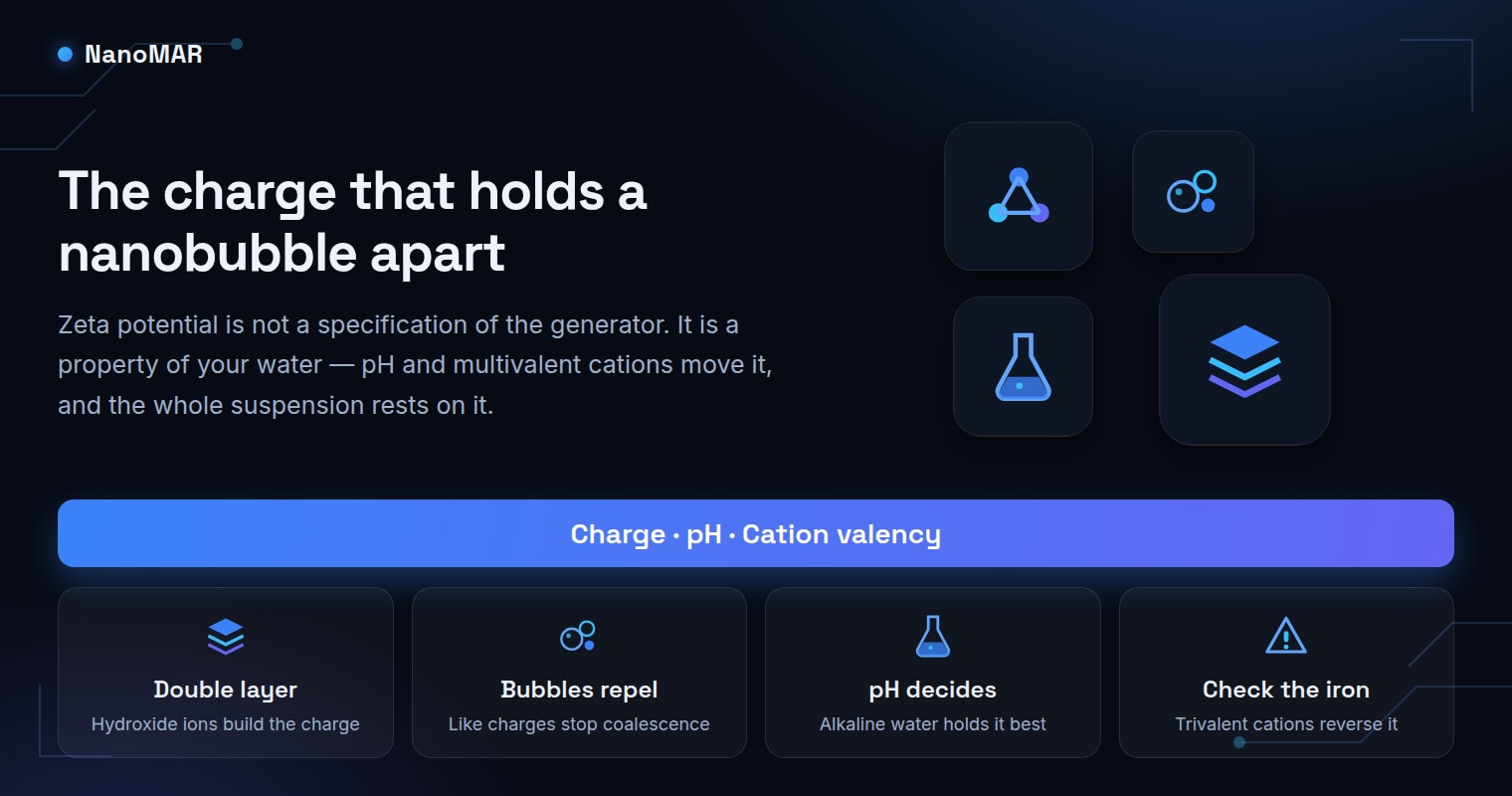
Zeta potential is the electrical potential at the slipping plane — the boundary between the thin shell of liquid that travels with a particle and the bulk water that stays behind. It is reported in millivolts, and the sign tells you which ions have gathered at the interface. For a gas bubble in water that sign is negative, and the accepted explanation is that hydroxide ions adsorb preferentially at the gas–liquid boundary and build an electrical double layer around the cavity. Nothing is dosed to cause it. A nanobubble from a NanoMAR system takes its charge from the water itself, which is one reason the process leaves no by-products or residues — there is no coagulant in the loop to leave any. If the size definition behind all this is new, start with the introduction to what nanobubbles are.
Why does a surface charge keep nanobubbles apart?
Two bubbles drifting together feel van der Waals attraction pulling them closer. Like charges push back. Where repulsion wins, a population stays a population instead of consolidating into fewer, larger bubbles — and that is the whole trick, because it is the enormous combined gas–liquid interface of the suspension that drives near-complete gas transfer. Coalescence destroys interface area. The charge defends it.
Buoyancy stopped mattering long before this scale. Below 200 nm a nanobubble is effectively neutrally buoyant and stays suspended for days to weeks, where a coarse bubble rises and bursts in seconds. Nirmalkar, Pacek and Barigou tracked the zeta potential of bulk nanobubbles over time in Langmuir and found it did not drift. Neither did the mean diameter. Their argument is that the constancy of the charge is the stability.
What does the charge do to suspended solids in the water?
A nanobubble does not float a particle by being buoyant. It attaches, and enough attachments to the same floc eventually lift it — which is how NanoMAR systems reach published removal of 80 %+ of suspended matter, turbidity reduction of 50 %+ and 40 %+ higher oxygen transfer with no chemical added. The charge earns its keep twice over: it keeps bubbles from merging on the way to the particle, so the population arriving is still vast in number, and a charged interface interacts with a particle's charged surface rather than sliding past it. What leaves the water phase also means less liquid to dewater downstream.
Why zeta potential is important for nanobubbles in hard and saline water
Here is the part the datasheets gloss over. Two variables dominate the charge: pH, and the valency of the cations in solution. The Birmingham group found bulk nanobubbles more stable in alkaline water than acidic, and found added salt pushed the negative zeta potential towards zero. Aluthgun Hewage, Kewalramani and Meegoda went further in Colloids and Surfaces A, testing sodium, calcium and iron salts: the differences came down mainly to pH and cation valency, and high-valency cations could neutralise or even reverse the surface charge. Anions barely moved it.
| What is in the water | Effect on the charge | What you notice on site |
|---|---|---|
| Alkaline, low-salinity water | Stays strongly negative | The favourable case: longest-lived suspension |
| pH drifting acidic | Fewer hydroxide ions for the double layer | Bubbles coalesce sooner than expected |
| High dissolved solids, seawater | Double layer compressed towards zero | Contact time and dose point matter more |
| Calcium hardness | Divalent cations reduce the charge | Flotation less selective than on soft water |
| Dissolved or particulate iron | Trivalent cations can reverse the charge | Check iron before blaming the equipment |
None of this rules out hard or saline water. Nanobubbles are used across aquaculture, wastewater, mining and desalination, and none of those waters is anyone's idea of clean. What it rules out is quoting a performance figure before someone has looked at the water — which is why NanoMAR runs membrane, venturi and ceramic separation on one platform rather than one stage for every duty.
Measure the zeta potential in the water you intend to treat, at its working pH. A value from deionised water tells you about deionised water.
How do you measure the zeta potential of nanobubbles?
Not directly. The instrument applies an electric field across a sample cell, tracks how fast the population drifts, and converts that mobility into a potential — so the figure is the end of a chain of assumptions about the cell, the ionic strength and the shape of the double layer. Treat it as comparative. It is good at telling you this water is worse than that water, and weak as an absolute value to put in a contract. A measurement worth the time has these attached:
- Water you will actually treat, at working temperature — not deionised water, and not a bucket that stood overnight.
- The pH, recorded with every reading. A zeta potential with no pH beside it cannot be interpreted.
- The multivalent cation load: calcium hardness, and iron especially, dissolved and particulate.
- A size distribution from the same session, because charge and diameter are read together or neither means much.
- Repeats over days, not minutes — the real question is whether the value drifts.
Frequently asked questions
Why is zeta potential important for nanobubbles?
Zeta potential is the negative surface charge that keeps NanoMAR's nanobubbles from merging into larger bubbles, which would simply rise and burst. Because the cavities stay under 200 nm and stay apart, they remain suspended for days to weeks, and that same charge is what lifts suspended contaminants out of the water.
Do nanobubbles always carry a negative zeta potential?
In most fresh water, yes — a gas–liquid interface takes on a negative charge with nothing dosed to cause it. Published research shows that low pH and high-valency cations such as calcium and iron reduce or even reverse it, which is why NanoMAR sizes nanobubble systems against a sample of the customer's own water.
Can the zeta potential of nanobubbles be changed without chemicals?
Not directly, and NanoMAR does not attempt it. Nanobubble generation doses no coagulant or biocide, so there are no by-products or residues, and the charge comes from the water chemistry itself. What can be changed is where the water is dosed and how long gas and liquid stay in contact.
What I learned the hard way is that surface charge is the question I should ask first and almost always asked last. Most of my work has been RAS water quality and design optimisation on recirculating systems, and for years I filed zeta potential under theory — true, elegant, not operational. Wrong. When flotation underperformed I assumed the generator was the variable, so that is where I looked. Every time. It was usually the make-up water, which nobody had characterised beyond temperature and dissolved oxygen. My first question on a new loop is now a dull one: what has the pH done over a week, and is there iron in the intake?
Every term used here is defined in the nanobubble glossary. If you already know your water is hard or iron-bearing, say so early — send the analysis and the duty, and we can work through what a pilot would have to prove.