Sub-200 nm gas bubbles behave nothing like ordinary bubbles — here is what makes them so effective for water.
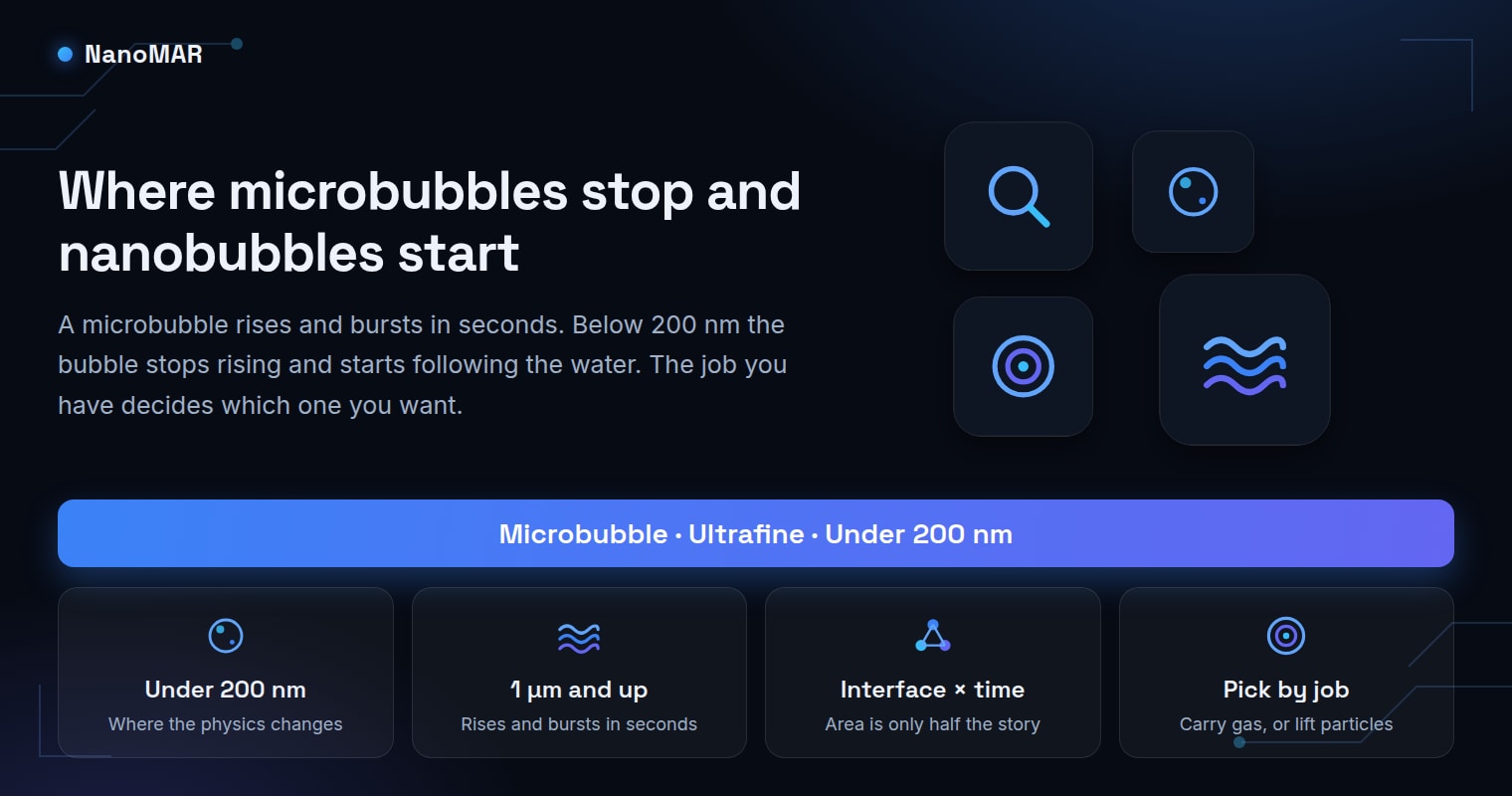
A nanobubble is a gas-filled cavity smaller than 200 nanometres — thousands of times smaller than the bubbles you see from an air stone. At that scale, physics changes.
Ordinary bubbles rise and burst within seconds. Nanobubbles are neutrally buoyant, so they stay suspended in water for days or even weeks. They carry a strong negative surface charge that attracts and lifts contaminants, and their enormous combined surface area dissolves gas into water with remarkable efficiency.
The result is water that holds more oxygen, stays clearer, and resists biofilm — all without adding a single chemical. That is the foundation of every NanoMAR system.
What is a nanobubble, and why does 200 nm matter?
A nanobubble is a gas-filled cavity in water under 200 nanometres across. That is the whole definition. Nothing is dosed to make one and nothing is added to hold it together — the only input is gas, whether oxygen, air or ozone. What changes at that size is the physics, and everything a nanobubble does for water follows from it.
To see why 200 nm is the line, start at the other end of the scale. Release air through a diffuser and you get millimetre-scale bubbles. Buoyancy overwhelms everything else acting on them; they reach the surface in seconds, and whatever gas has not dissolved on the way up is delivered to the room. More pressure only makes them arrive sooner.
Shrink the same bubble far enough and the balance of forces inverts. Below roughly 200 nm a bubble is effectively neutrally buoyant: it travels wherever the water travels, and it carries a strong negative charge on its surface. A bubble that never reaches the surface never bursts, so instead of seconds it persists for days and weeks.
The vocabulary is messier than the physics
Ultrafine bubbles is what much of the bubble-science literature calls the same object. Bulk nanobubbles separates bubbles suspended in the liquid from surface nanobubbles pinned to a solid. Micro-nano bubble, common in equipment catalogues, usually signals a mixed distribution rather than a nanoscale one — which is why we would rather state nanobubble size as a measured number than a category name.
Why do nanobubbles not rise and burst?
Two scaling laws decide it. Buoyant force follows the volume of the bubble, so it falls with the cube of the radius; the viscous drag resisting motion through water falls roughly in proportion to the radius alone. Take the radius down far enough and buoyancy loses outright — the rise velocity of a small sphere goes with the square of its radius.
A second effect arrives at this scale. Water molecules are in constant thermal motion, and they knock an object that small about hard enough that the random jostling becomes comparable with the upward pull still acting on it. The bubble stops climbing and behaves like anything else in colloidal suspension. Bursting never gets its chance either, because a bubble that never meets a free surface has no film to fail, and the gas inside has a single route out: into solution.
There is a catch, and it is the strongest objection to the whole idea. Surface tension holds a bubble under an internal pressure that climbs steeply as the radius falls, and classical diffusion theory says that pressure ought to drive the gas into solution almost at once. Measured populations persist anyway, and reproducibly.
What is zeta potential, and why does surface charge matter?
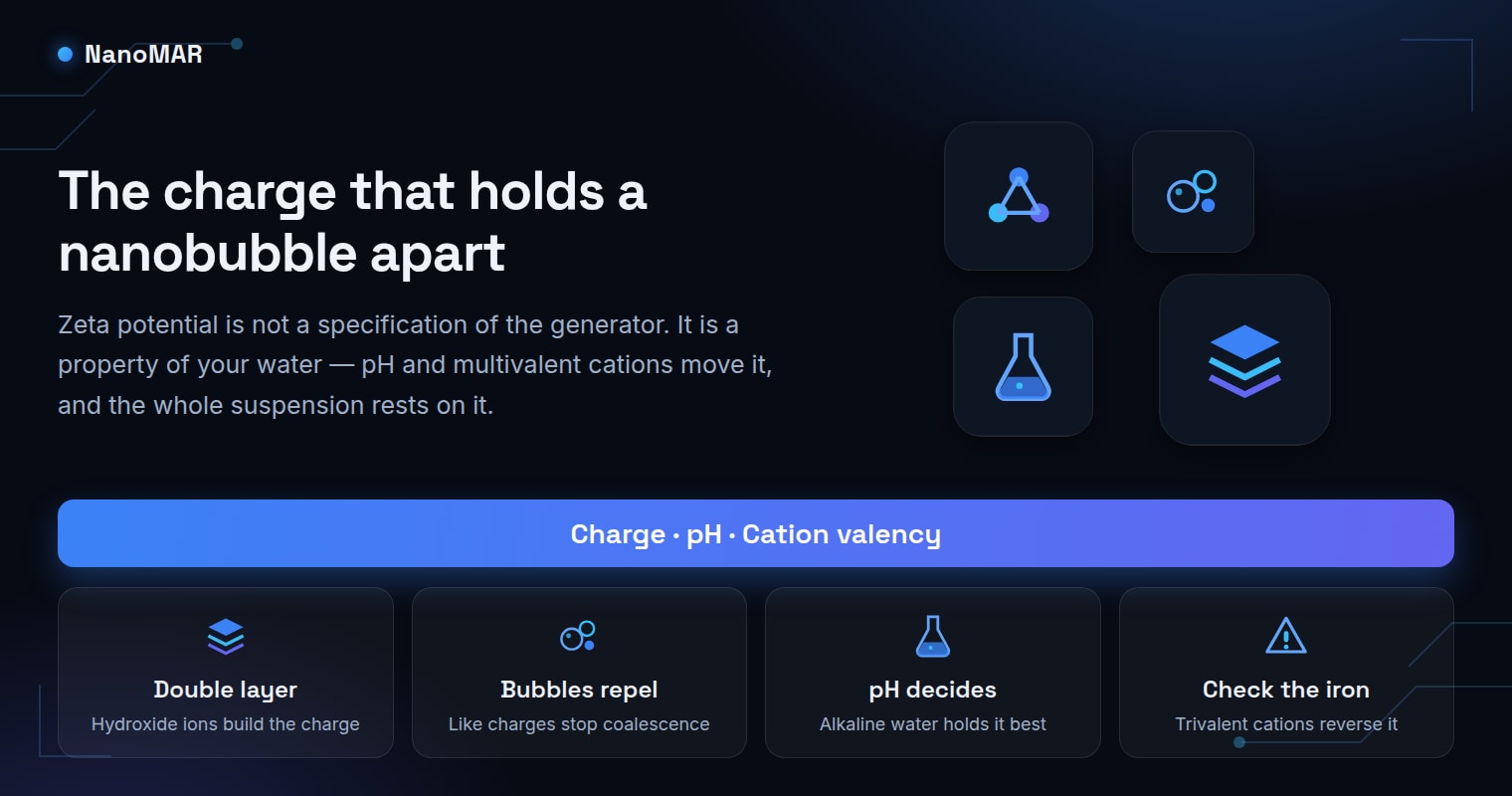
The gas–water interface is not electrically neutral. Ions arrange themselves around it, leaving the bubble surface with a net negative charge and a diffuse layer of counter-ions. Zeta potential is the potential at the plane where that outer layer shears away as the bubble moves — convenient, because it is the part an instrument can report.
Nanobubbles carry a strong negative zeta potential. Two consequences follow.
They repel one another
Every bubble in the cloud carries charge of the same sign, so they push each other apart. Coalescence — fine bubbles merging into large ones that then rise and burst in the ordinary way — is the normal fate of every other kind of fine bubble. Electrostatic repulsion is what prevents it here. Stability is charge doing work.
They attach to the things you want gone
Suspended solids, oil films, organic matter and the conditioning layers biofilm builds on all carry surface charge of their own. A charged interface drifting past attaches to them, and a particle with bubbles attached is less dense than the water around it, so it floats. That is the mechanism behind NanoMAR's published 80 %+ suspended-matter removal and 50 %+ turbidity reduction, and why the same equipment lifts oil off metal without a detergent.
So ask any supplier for zeta potential alongside size distribution. A bubble size with no charge measurement behind it describes half the object.
Why do nanobubbles stay stable for days and weeks?
Honest answer first: the observation is better established than the explanation. That bulk nanobubbles persist for days to weeks is reproduced routinely; why they defy the diffusion argument is still argued about. Two mechanisms carry most of the weight.
Electrostatic pressure at the interface. The charged surface pushes outwards against the surface tension trying to collapse the bubble, reducing the internal pressure and with it the gradient driving gas into solution.
Local saturation. Gas leaving the bubble has to go somewhere, and in a shell of water already saturated with that gas there is nowhere to go — so dissolution stalls rather than running to completion.
What shortens the lifetime on a real site
Stability is a property of the water, not the bubble alone, and the same generator gives two different results in two different waters. High ionic strength compresses the electrical double layer and reduces the zeta potential, which is why seawater and fresh water do not behave identically. Surfactants and heavy organic loading attack the interface directly. Violent shear — a throttled valve, or coarse aeration downstream — strips a nanobubble population out faster than anything else on a plant.
Persistence is a physical property, not a promise about your dissolved-oxygen trace. In a stocked tank the oxygen is consumed as fast as you deliver it. Days to weeks is how long the bubbles stay in suspension if nothing uses them — not how long a reading stays high while the process breathes. There is more on the mechanism in nanobubble technology in practice.
How do nanobubbles compare with microbubbles and coarse bubbles?
These are not three points on a scale where finer is simply better. They behave differently enough to count as three technologies with three different jobs.
Bubble class
Diameter
Behaviour in water
Lifetime
Where the gas ends up
Coarse bubbles
Millimetres and up
Rises in a fast, straight column and bursts at the surface
Seconds
Largely in the air above the tank
Microbubbles
Micrometre scale
Rises slowly, clouds the water, coalesces or dissolves on the way
Short-lived — it rises or dissolves
Partly dissolved, partly lost
Nanobubbles
Under 200 nm
Effectively neutrally buoyant, travels with the water, strongly charged
Days to weeks
Near-complete dissolution into the water
A mixed size distribution can be described in the language of the third row while behaving like the second. Ask for the measured size distribution, never the category name.
What does this mean for water treatment?
Four properties, four consequences. These are the figures NanoMAR publishes for its own systems.
80 %+
Suspended-matter removal
Charged bubbles attach to particles and float them out
50 %+
Turbidity reduction
What removing the fine fraction does to clarity
40 %+
Oxygen-transfer increase
More interface, far longer contact, less gas lost to air
Zero
Chemicals added
Only gas goes in, so no by-products come out
Which water problems does the physics actually solve?
Every application below is one of two properties doing its job: bubbles that persist, or bubbles that carry charge. That is why one platform reaches 9+ industries.
Oxygenation and aeration
Dissolved oxygen held across a whole tank rather than in a plume above the diffuser, because the bubbles travel with the water.
Disinfection with ozone
Ozone nanobubbles carry the oxidant to the surfaces where pathogens and biofilm live, and leave no residue behind them.
Flotation and separation
Negative surface charge attaches to solids and oils, lowers their effective density and floats them where they can be skimmed.
Algae and biofilm control
Persistent bubbles reach pipe walls, membrane faces and tank corners a rising bubble column never touches.
Surface cleaning
The same attachment mechanism lifts grease off metal without a detergent, and so without a detergent to rinse away.
Irrigation and root health
Oxygen delivered as far as the root zone rather than lost at the surface — a distribution problem before it is a transfer one.
The question that separates two nanobubble quotations is never whether the physics works. It is what fraction of the gas is genuinely under 200 nm in your water, at your temperature, after your pump.
The physics is genuinely useful and it is not universal. A supplier who will not tell you where the technology stops is not worth listening to about where it works.
They do not remove dissolved substances. Flotation acts on things a bubble can attach to. Anything truly in solution is untouched, however small the bubble.
They are not a filter. Charged bubbles bring solids to the surface. Something still has to skim, drain or filter them off, or they settle back.
Oxygen is not nitrogen management. Nanobubbles supply the oxygen nitrifying bacteria need; the bacteria do the conversion. A system short of biofilter surface stays short of it.
They will not fix hydraulics. Nanobubbles travel with the water, so where a tank short-circuits or holds a dead corner, the treated water does not reach it either.
Ozone still has to be designed for. Ozone nanobubbles are an effective disinfection route, and ozone remains a strong oxidant needing control, containment and competent handling.
To see the same physics applied to one setting rather than explained in general, the companion piece on nanobubbles in land-based fish farming is the closest; the rest of what we publish is indexed on the NanoMAR blog.
Frequently asked questions
What are nanobubbles, in one sentence?
Nanobubbles are gas-filled cavities in water smaller than 200 nanometres — small enough to be effectively neutrally buoyant, so they stay suspended for days to weeks instead of rising and bursting within seconds. NanoMAR generates them from oxygen, air or ozone with no chemical dosing.
How big is a nanobubble compared with a normal bubble?
A nanobubble is under 200 nm across, a microbubble is micrometre-scale, and a diffuser bubble millimetre-scale. That difference in nanobubble size changes the behaviour: coarse bubbles rise and burst in seconds, while the nanobubbles a NanoMAR generator produces stay in the water column and keep transferring gas.
How long do nanobubbles last in water?
Bulk nanobubbles persist for days to weeks, because a strong negative zeta potential keeps them from merging into larger bubbles that would rise and burst. In a working NanoMAR installation the practical lifetime is shorter, since fish, bacteria and oxidation reactions consume the gas the bubbles carry.
Are nanobubbles and ultrafine bubbles the same thing?
Yes. Ultrafine bubbles is the term much of the bubble-science literature uses for the object NanoMAR calls a nanobubble: a gas cavity under 200 nm suspended in the body of the liquid. Equipment marketed as a "micro-nano bubble" generator is a different claim, usually a mixed size distribution.
How are nanobubbles generated?
They are made by shearing gas into water under controlled pressure, using a membrane, a venturi or a ceramic element. NanoMAR builds all three separation technologies onto one platform, because the right choice depends on the water it will see — our page on how a nanobubble generator is sized covers each method.
Do nanobubbles need chemicals to work?
No. A NanoMAR system doses nothing into the water — the only input is gas, whether oxygen, air or ozone — so there are no by-products and no residues to remove afterwards. That is why nanobubble treatment suits duties where a chemical residue would be unacceptable in the discharge or the product.
What to measure before you believe any of it
Microbubbles cloud water; nanobubbles do not, so a treated tank looks exactly like an untreated one. Every claim made about them — ours included — is worth as much as the instrument behind it. This is the shortlist we would want.
Size distribution, and the method behind it. Not a headline median. What fraction is genuinely under 200 nm, measured how, and in which water.
Zeta potential. Charge is the mechanism behind stability and flotation alike. A size figure with no charge figure describes half the object.
Dissolved oxygen at several points. One probe near the inlet says nothing about the far end of a tank, and distribution is the whole argument for nanobubbles over diffusers.
Turbidity and suspended solids on one instrument. Before and after, same device, same sampling point, same time of day. Swapping instruments part-way through invalidates the comparison.
Energy per kilogram of gas transferred. Not motor rating. A machine drawing less power while losing gas to the atmosphere is the more expensive one to run.
A baseline long enough to include a bad day. Temperature swings, peak feeding, storm loading. A fortnight of good weather is not a baseline you can defend later.