Waste & effluent treatment
NanVANN Pro
A complete nanobubble treatment unit for aquaculture wastewater and industrial effluent, supporting TSS/TOC reduction, TAN management and polishing steps.
5–500 m³/h
At a glance
- Waste management
- Water-quality improvement
- TSS & TOC reduction
- TAN management
Capacity and performance
A hundredfold span between the smallest and largest duty, because effluent flows vary that much between a land-based farm and a municipal-scale plant.
What it actually removes
The NanVANN Pro is specified against three things rather than one, and it is worth separating them because they are achieved by different routes.
TSS — total suspended solids. This is flotation. Nanobubbles carry a strong negative surface charge, attach to fine particles that would otherwise stay in suspension, and carry them to the surface where they can be skimmed. It is the mechanism behind the published 80 %+ suspended-matter removal, and the reason turbidity falls with it.
TOC — total organic carbon. Partly flotation again, for the particulate fraction, and partly oxidation where the unit runs on ozone. The distinction matters when you are reading a proposal: a supplier who folds both into one number is hiding which route their figure depends on.
TAN — total ammonia nitrogen. This one is management rather than removal. Nitrification is a biological process that is limited by dissolved oxygen at the bacteria; hold oxygen properly through the reactor and the biology does the work it was always capable of. That is why an oxygen-transfer improvement shows up as an ammonia result.
Technical specifications
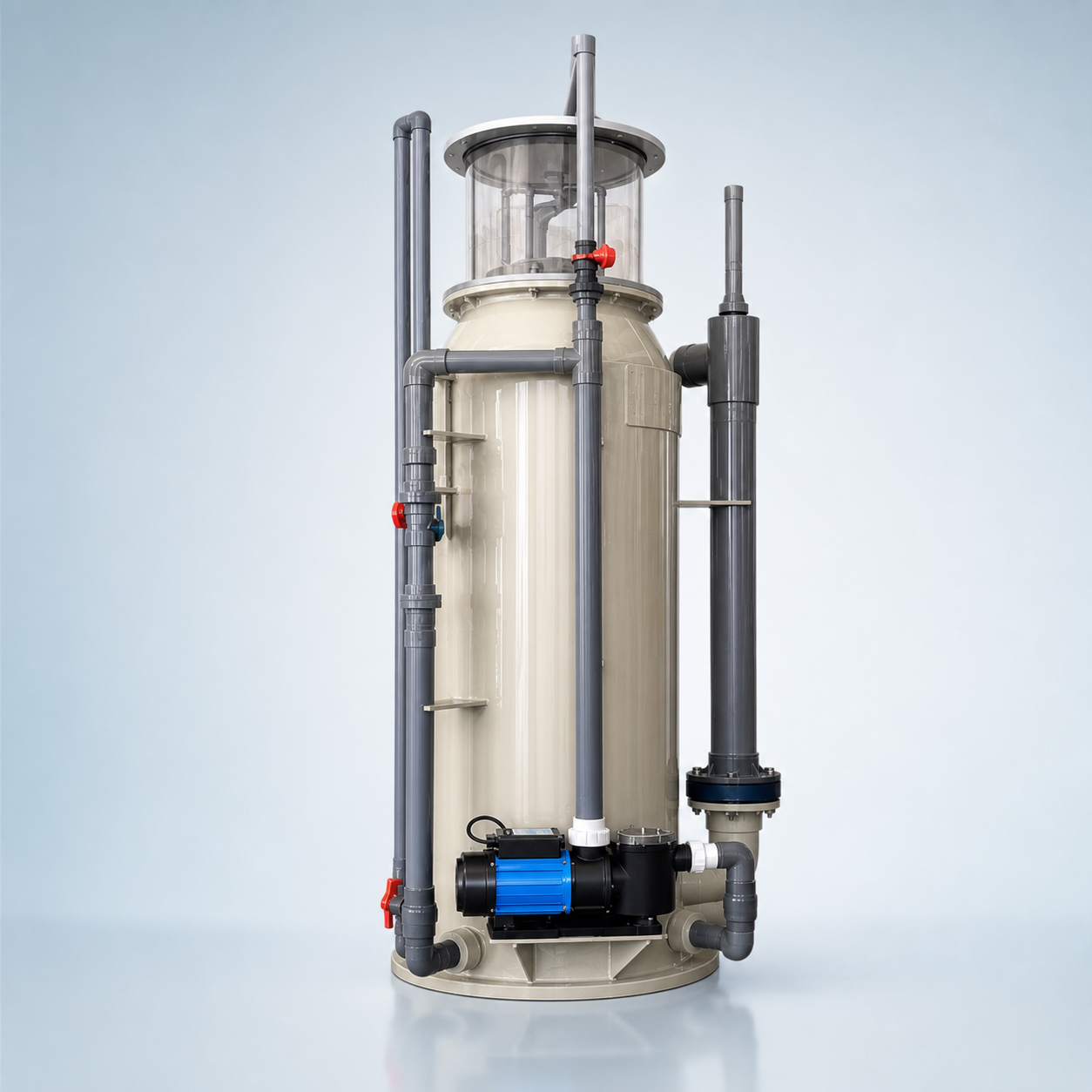
A complete treatment unit rather than a bare generator: the NanVANN Pro is the one unit in the NanoMAR range built for aquaculture wastewater and industrial effluent, covering TSS and TOC reduction, TAN management and polishing duty.
Effluent is the least forgiving water on any site — variable, loaded, and frequently abrasive — which is why the choice of separation stage matters here more than on clean-water duty and is made against your actual water rather than a category.
Gas options: O2, air, ozone
On an effluent duty the gas choice is usually the largest single decision in the specification.
Oxygen
Where the biology is the constraint. Highest dissolved concentration, and the sensible choice when the reactor is oxygen-limited at peak load.
Air
No gas supply to arrange. Lower ceiling on dissolved oxygen, but often sufficient for polishing duty and lighter organic loads.
Ozone
For oxidising the fraction biology cannot, and for odour. Reverts to oxygen, so nothing is added to the sludge or the discharge.
Typical applications
Where a NanVANN Pro is usually specified, and what it is being asked to do.
| Application | The duty | What changes |
|---|---|---|
| Aquaculture wastewater | Solids and organics before discharge | Flotation of fine solids that a settling stage does not catch |
| Industrial effluent | Variable organic load | Oxygen held through load swings instead of collapsing on the peak |
| Sludge handling | Volume and odour | Better aerobic digestion; less liquid to dewater and haul |
| Polishing duty | The last stage before discharge | Turbidity and residual solids taken down without dosing a coagulant |
| Odour control | Anaerobic pockets | Oxygen reaching the corners of the tank the diffuser grid never did |
Installation and integration
Effluent installations are almost always retrofits, and the constraint is rarely the technology.
-
01
Characterise the influent honestly
Flow, BOD and COD, suspended solids, ammonia — and how far each swings between the quietest hour and a clean-in-place cycle. Equipment sized on the average fails on the peak.
-
02
Side stream on the existing loop
The unit takes a slipstream and returns it, so it can be isolated for service while the plant keeps running. On a treatment works that is usually non-negotiable.
-
03
Decide where in the train it sits
Ahead of the biological stage to reduce its load, or after it as a polishing step. The two answers give different sizing and different results.
-
04
Settle the gas supply
Oxygen means a generator, a tank or a contract; ozone means a generator and the handling that goes with it. This is a plant decision, not an accessory.
-
05
Agree the compliance baseline
Measure against the parameters your consent is written in, over a period long enough to include a bad week.
Energy use
On a treatment works, aeration is usually the largest electrical load on site, so this is the section that decides the business case.
The mechanism is straightforward. A coarse bubble delivers a fraction of its gas to the water and the remainder to the air above the tank; a nanobubble stays in the water column and transfer approaches completion. NanoMAR publishes 40 %+ higher oxygen transfer and lower energy operation on that basis.
What we will not publish is a percentage saving, and you should be sceptical of anyone who does. The honest figure depends on your alpha factor, your temperature, your tank geometry and the condition of your existing diffusers. Build the comparison in the one unit that makes two proposals comparable — kilowatt-hours per kilogram of oxygen actually transferred — and ask every supplier, including us, to state the conditions their figure was measured under, which is exactly what our pilot and measurement protocol exists to record.
Frequently asked questions
- What flow does the NanVANN Pro handle?
The NanoMAR NanVANN Pro covers 5–500 m³/h, which spans a small land-based aquaculture effluent stream up to industrial and municipal-scale duty. It is a complete treatment unit rather than a bare generator.
- What does it do about ammonia?
TAN management works through the biology rather than around it. Nitrifying bacteria are limited by dissolved oxygen at the floc, and NanoMAR nanobubbles hold oxygen through the reactor — including the corners a diffuser grid does not reach — so the nitrification the plant was designed for actually happens.
- Does it replace chemical dosing?
For the flotation duty it frequently does: NanoMAR publishes 80 %+ suspended-matter removal and 50 %+ turbidity reduction with zero chemicals added, so there is no coagulant residue in the sludge or the discharge. Whether it replaces dosing entirely depends on what else your consent requires.
- Where in the treatment train does it go?
Either ahead of the biological stage to reduce the load reaching it, or after it as a polishing step before discharge. NanoMAR sizes the NanVANN Pro differently for each, so the decision belongs at the start of the conversation rather than the end.
Download datasheet
Datasheets, like what the unit will cost, are issued with a quotation rather than published. On an effluent duty that is not evasion: the useful document states what the unit does with your influent at your load, and a sheet written for an average stream would misinform you about both.
Send the influent characterisation and you will get a specification against it. Our duty-point calculator covers the oxygen side of the question before you send it.
Request a quote
Flow, BOD and COD, suspended solids, ammonia, and what your consent requires. We will work the oxygen budget with you.
Specifications
| Flow range | 5–500 m³/h |
| Bubble size | < 200 nm |
| Gas options | Oxygen · Air · Ozone |
| Separation stages | Membrane · Venturi · Ceramic |
| Operation | Continuous, automated |
| Chemicals | None required |
Ready to rethink your water?
Tell us about your process and we'll size a nanobubble system for it.
Talk to our team