All industries

Industries

Aquaculture

Stable dissolved oxygen and lower pathogen pressure for RAS, land-based and sea farms — nothing dosed into the water.

Aquaculture water treatment with nanobubbles means dissolving oxygen, air or ozone into farm water as gas cavities under 200 nm rather than releasing coarse bubbles from a diffuser. Those bubbles are effectively neutrally buoyant, so they stay suspended for days to weeks and keep transferring gas instead of venting at the surface; NanoMAR publishes 40 %+ higher oxygen transfer. Nothing is dosed into the water, so no by-products or residues are left behind.

Aquaculture

Recirculating (RAS) and land-based fish farms depend on precise water quality. NanoMAR dissolves oxygen as gas cavities under 200 nm: effectively neutrally buoyant, so they stay suspended for days instead of venting at the surface, and dissolved oxygen holds across the whole tank rather than near the diffuser. The published figure is 40 %+ higher oxygen transfer.

Ozone nanobubbles act on pathogen pressure through the same mechanism, and because nothing is dosed there is no residue to manage downstream. NanoMAR publishes no growth, survival or feed-conversion figures — what the change is worth on your site is what a pilot on your own water is for.

The challenge: oxygen, disease pressure, feed conversion

Three constraints govern a fish farm, and they are coupled: how much oxygen you can deliver, how much pathogen pressure the water carries, and how efficiently feed becomes biomass.

Oxygen is the binding constraint, not tank volume

Standing biomass is limited by the rate oxygen goes in and carbon dioxide comes out. Demand rises after feeding, with temperature and as fish grow, so a system sized on a daily average runs short when the fish work hardest.

Pathogen pressure travels with the solids

Fine particles are surface area, and surface area is where bacteria live. Each reuse pass concentrates organics and feeds biofilm in pipework and media, so removing fine solids is biosecurity, not housekeeping. Both constraints report through one slow instrument: feed conversion drifts well before the mortality log does. We set out why bubbles under 200 nm behave differently in detail.

Dissolved oxygen as a control parameter

Dissolved oxygen is usually read as a number on a screen. Treat it as a controlled variable instead: an instrument, an actuator that adds gas, and disturbances — feeding, grading, a warm week — that the loop must absorb.

Most farms have a good instrument and a poor actuator. A diffuser transfers gas as a function of depth and contact time, so much of any increase leaves through the surface as off-gas.

Gas sheared into cavities under 200 nm barely rises. The bubbles stay suspended for days to weeks across an enormous gas–liquid interface, so the water column works as a reservoir rather than a leaky pipe: NanoMAR publishes 40 %+ higher oxygen transfer. Measure where the fish are, never in the injection plume. And prefer pure oxygen to air on heavy duty, since it keeps nitrogen out of the transfer.

RAS and land-based farming

A recirculating aquaculture system is a chain of unit processes, and their order matters more than the equipment: tank outlet, solids removal, biofilter, degassing, oxygenation, back to the fish. Nanobubble generation belongs on the pumped side stream after degassing. Dose oxygen upstream of a stripping column and you pay to put gas in, then pay again to blow it out.

The biofilter is an oxygen consumer too

Nitrification is aerobic. Bacteria converting total ammonia nitrogen to nitrite and nitrate draw on the same budget as the fish, continuously, including overnight when feeding has stopped. A budget from fish respiration alone is wrong.

Land-based salmon farming changes the economics

Tempered water means every cubic metre of make-up carries an energy cost, so a lower exchange rate shows on the power bill as much as in the fish-health record. Ozone belongs here too — a designed contact stage, residual handled before the water meets fish — putting the oxidant where biofilm sits, with no chemical residue. More in nanobubbles in aquaculture.

Sea cages and flow-through

Nanobubbles hold their effect in water you control. In open water you are treating the fjord, and we will say so rather than sell a skid.

Sea cages

An open pen exchanges its volume with the current, so injected gas leaves with the water it went into. We would not specify a generator for open-cage oxygenation.

Flow-through farms

Single-pass sites size against flow, not biomass, because nothing accumulates. A unit on the pumped intake lifts the incoming concentration once, and the duty follows the pump curve.

Wellboats and holding tanks

Contained water, high biomass, short duty. Demand spikes through loading, and one skid can hold concentration throughout.

Hatchery and smolt stages

Sensitive fish, no tolerance for pathogen pressure. The case for ozone nanobubbles on incoming water is strongest here.

Intake water and biosecurity

The intake is where a pathogen problem is cheapest to solve. These are the points we work through before specifying anything.

  • Know the source across the year. Fjord, river, borehole and surface water bring algae, run-off and turbidity peaks onto the intake first.
  • Solids before oxidant. Particles carry organisms and shield them, so disinfection works only on water the filtration stage has cleaned.
  • Contact volume, not a dosing point. Ozone needs designed contact time, and nanobubbles keep it in suspension rather than letting it rise out.
  • Protect the pipework, not only the tank. Biofilm establishes in intake lines, sumps and dead legs. A treated intake feeding a colonised pipe run is not a treated intake.
  • Log it from the first day. Turbidity, dissolved oxygen and oxidant residual, recorded continuously. Without a baseline nothing can be demonstrated later.

Sludge handling

Sludge decides whether a discharge consent feels comfortable or tight. It leaves the farm as drum-filter backwash and settled solids: dilute, biologically active, expensive to move because most of it is water.

Nanobubbles carry a strong negative zeta potential, and that charge lifts fine particles rather than merely stirring them. Attached to a particle, a bubble lowers its effective density and floats it — which is why the platform that oxygenates a tank also thickens a sludge stream. Published figures: 80 %+ suspended-matter removal and 50 %+ turbidity reduction. Denser sludge means fewer transports and a lower cost per cubic metre of dewatered mass.

Reject water from thickening is heavy in organic carbon and total ammonia nitrogen, and it is usually the stream that pushes a site against its permit. NanVANN Pro is built for that duty — TSS and TOC reduction with TAN management across 5–500 m³/h — on gas alone. Odour is the same problem in another hat: a sludge tank smells because it has gone anaerobic. See the nanobubble system in practice.

Documented results

These figures describe the platform, not a named farm. No customer has yet released a project for publication, and a platform figure is never re-attributed to a site.

80 %+
Suspended-matter removal
Fine solids lifted by bubble charge
50 %+
Turbidity reduction
Against the water's own baseline
40 %+
Oxygen-transfer increase
Gas dissolved, not lost at the surface
Zero
Chemicals added
Only oxygen, air or ozone
Under 200 nm
Bubble diameter
Small enough to stay suspended
Do not take our numbers on trust, or anyone else's. Give us your own dissolved-oxygen logs from before anything is installed, then the same probes in the same positions afterwards.
Behnood Sjåstad Fathi Co-founder and CTO, NanoMAR AS — 6+ years on international aquaculture water-treatment projects

How would you prove it on our farm?

NanoMAR AS has built nanobubble systems from Bergen since 2023, and no customer has yet cleared a project for publication. So instead of a case study, we run a measured trial and hand over the data. Baseline first: dissolved oxygen at the tank outlet and in the fish zone, turbidity and suspended solids, logged on your instruments in fixed positions. The unit then goes in on a side stream that can be isolated, and the same instruments record the same points. Nothing is compared across seasons, or against a different probe. Our page on how a pilot is run and documented has the protocol.

FAQ

What is aquaculture water treatment with nanobubbles?

It means dissolving oxygen, air or ozone into farm water as gas cavities under 200 nm rather than releasing coarse bubbles from a diffuser. Those bubbles stay suspended for days to weeks, so gas keeps transferring after the water leaves the unit. NanoMAR builds these systems in Bergen and publishes 40 %+ higher oxygen transfer.

Can nanobubbles be used in a recirculating aquaculture system?

Yes. In a recirculating aquaculture system a NanoMAR generator sits on a pumped side stream after degassing, so oxygen is not stripped out again by the CO₂ column. The same platform feeds ozone into a contact stage, and only gas is added.

How do nanobubbles raise dissolved oxygen on a fish farm?

A NanoMAR generator shears oxygen into bubbles under 200 nm, which present an enormous gas–liquid interface and stay in the water column instead of venting at the surface. More gas ends up dissolved: the published figure is a 40 %+ increase in oxygen transfer.

Do ozone nanobubbles leave a residue in fish water?

No. A NanoMAR system adds only gas — oxygen, air or ozone — so nothing is dosed and no by-products or residues are left to strip out. Ozone is an oxidant, so it still belongs in a designed contact stage, with the residual handled before the water reaches fish.

How should intake water be treated before it reaches the fish?

Solids first, disinfection second, because particles shield organisms from any oxidant. NanoMAR uses ozone nanobubbles for the disinfection stage, holding the oxidant in suspension instead of letting it rise out. Our intake water treatment page covers source types and contact volume.

Which NanoMAR unit suits land-based salmon farming?

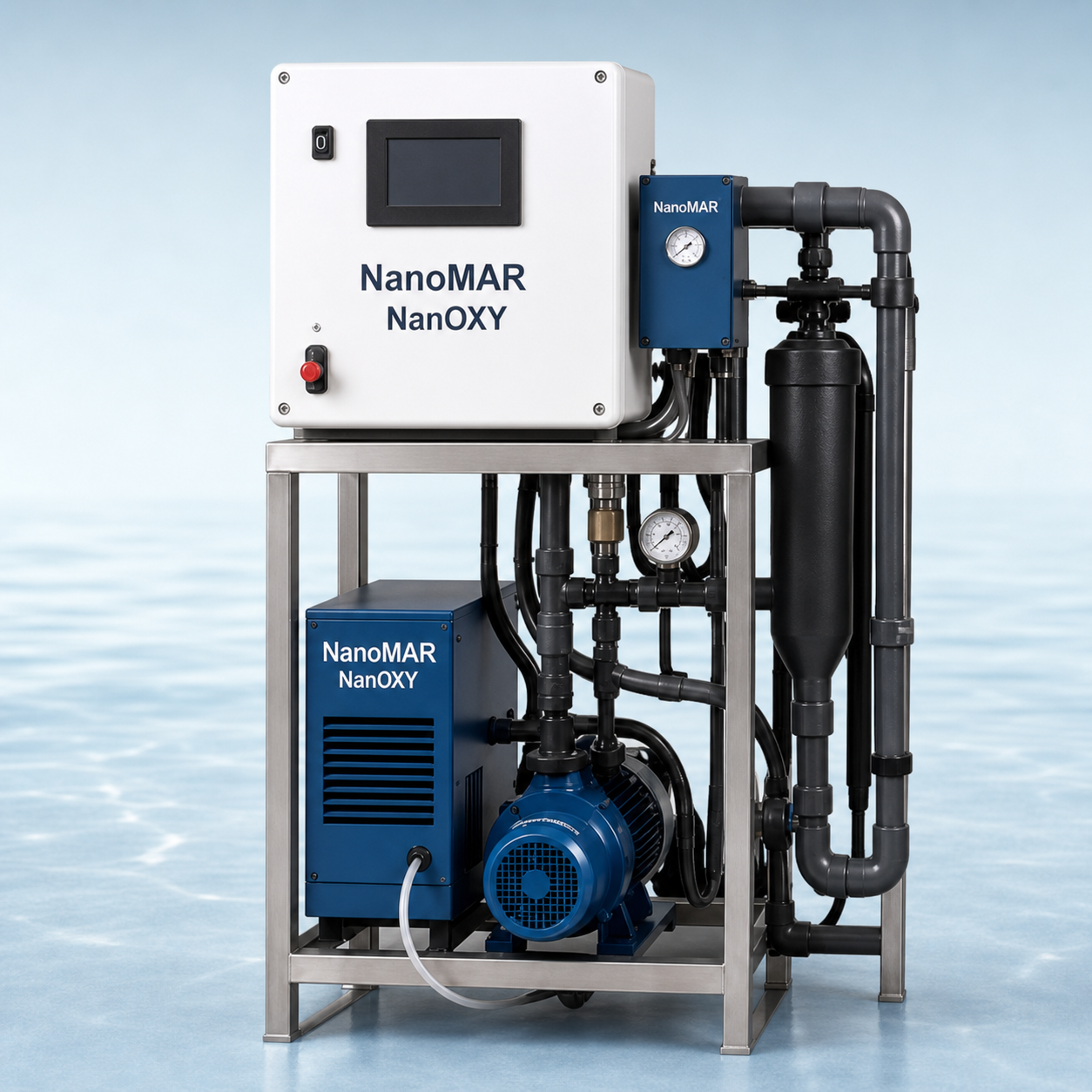
Usually NanOxy Pro: a skid delivering 18.9 m³/h at 40 mg/L, 37.8 m³/h at 20 mg/L or 75.6 m³/h at 10 mg/L. To validate on one loop first, NanOxy M Pro covers 10–100 m³/h. NanoMAR sizes both against the oxygen budget, not tank volume.

Tell us what your water is doing

Send your flow, your target concentration and your dissolved-oxygen logs, and our engineers in Bergen will work through the sizing with you.

Talk to an engineer

Ready to rethink your water?

Tell us about your process and we'll size a nanobubble system for it.

Talk to our team