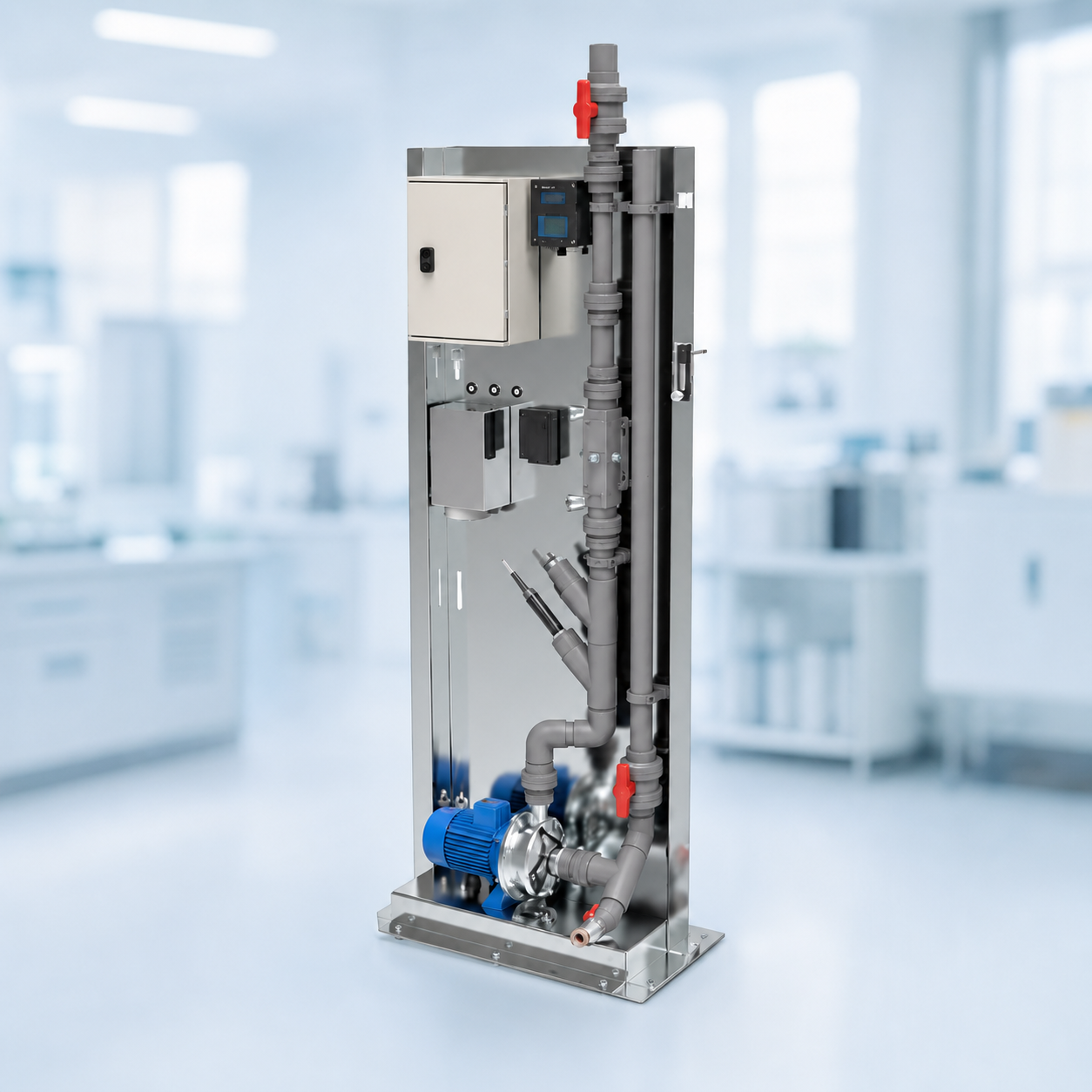
Portable laboratory unit
NanOxy S2
A portable, easy-to-set-up membrane nanobubble unit for oxygenation trials, pilot preparation and repeatable R&D validation.
2–50 lpm
At a glance
- Portable
- Easy to set up
- Laboratory scale
- Membrane based
Capacity and performance
The NanOxy S2 is a portable membrane nanobubble generator rated 2–50 lpm. Read the band as a range of trials, not a capacity claim: screening at the bottom, a pilot side stream at the top, one machine throughout.
Flow is what you set; contact is what you buy. Slow the unit down and each pass spends longer in the contactor; speed it up and you treat more water less thoroughly.
Scale-up is where that matters. NanOxy Pro is one skid with three published duty points: 18.9 m³/h at 40 mg/L, 37.8 m³/h at 20 mg/L, 75.6 m³/h at 10 mg/L — flow and delivered concentration trade directly against each other. Working out which of those numbers you should be buying is what an S2 programme is for. The rest of the nanobubble system range starts where the S2 stops.
Technical specifications
The third column is the one to read.
| Parameter | NanOxy S2 | What it decides |
|---|---|---|
| Flow range | 2–50 lpm | Screening and a pilot side stream in one band — no hardware change mid-programme |
| Generation method | Membrane | Pore structure sets the distribution, not pump effort; that is where repeatability lives |
| Bubble size | Under 200 nm | Effectively neutrally buoyant, so gas is not vented at the surface |
| Persistence | Days to weeks | Water keeps transferring gas downstream; place sample points accordingly |
| Gas options | Oxygen, air or ozone | Oxygenation and disinfection trials on one unit; only the supply changes |
Platform-wide specifications appear further down this page.
Gas options: O2, air, ozone
The unit barely notices which gas you feed it. The trial design does.
Oxygen
Highest dissolved concentration, and the only credible stand-in for a stocked tank.
Air
Nothing to source or store, so the rig runs sooner. Lower ceiling, but enough for mixing and flotation.
Ozone
Disinfection and biofilm trials rather than oxygenation. The oxidant travels in the water column and leaves no residue.
Typical applications
- Oxygenation trials. Build the dissolved-oxygen curve on your own water, so the production unit is sized on measurement.
- Ozone disinfection screening. Pathogen and biofilm work with nothing dosed and no residual to strip.
- Flotation and separation. NanoMAR publishes 80 %+ suspended-matter removal and 50 %+ turbidity reduction; a bench run shows how your solids compare.
- Irrigation and root health. Single-line trials before committing across a growing area.
Installation and integration
-
01
Side stream, not in-line
Draw from the loop, return downstream; the unit can be valved out without stopping the process.
-
02
Settle the gas supply first
A cylinder, concentrator, ozone generator or compressor constrains the rig more than the generator does.
-
03
Fix the baseline first
Agree instruments and sample points, then run untreated long enough to see normal variation.
-
04
Change one variable per run
The generation method stays constant, so the only thing that moved is what you moved.
Energy use
Motor rating is the wrong comparison. What scales to a production decision is energy per kilogram of gas actually transferred — a machine that draws less power while venting half its gas is the more expensive one to own.
Sub-200 nm bubbles stay in the water column rather than losing gas at the surface, so the same delivered concentration costs less gas and less pumping. NanoMAR publishes 40 %+ higher oxygen transfer. We publish no energy percentage, and distrust any quoted without a stated temperature, salinity and load. An S2 run gives you your own figure — the number behind what a nanobubble generator costs, and the starting point for your own oxygen budget.
Download datasheet
The sheet is issued on request rather than posted as a generic PDF. Email behnood.fathi@nanomar.no or call +47 995 02 103 with three things.
- The gas. Oxygen, air or ozone changes the supply and the handling.
- The water. Temperature, salinity and solids decide what a trial can honestly demonstrate.
- What you need to prove. The sheet then arrives with the parameters we would measure.
Before you decide
Frequently asked questions
- What flow rate does the NanOxy S2 handle?
The NanOxy S2 runs from 2 to 50 lpm. NanoMAR builds it as a portable membrane nanobubble generator, so the band covers bench screening and a small pilot side stream on one machine.
- Can the NanOxy S2 run ozone as well as oxygen?
Yes. The NanOxy S2 takes oxygen, air or ozone, producing bubbles under 200 nm from any of them. Nothing but gas enters the water, so no by-products or residues are left behind.
- Is the NanOxy S2 suitable for continuous production duty?
No. NanoMAR builds the S2 for oxygenation trials and pilot preparation; continuous duty belongs to NanOxy Pro at 18.9–75.6 m³/h or NanVANN Pro at 5–500 m³/h.
- How do I get an S2 datasheet or a quotation?
Email behnood.fathi@nanomar.no or call +47 995 02 103 with your flow, gas and water. NanoMAR quotes per installation rather than publishing a price, because duty and water chemistry move a total more than the model does.
Request a quote
Send the flow you want to trial, the gas you can supply and what the water is doing today. Our engineers in Bergen will return a configuration and a measurement plan.
Specifications
| Flow range | 2–50 lpm |
| Bubble size | < 200 nm |
| Gas options | Oxygen · Air · Ozone |
| Separation stages | Membrane · Venturi · Ceramic |
| Operation | Continuous, automated |
| Chemicals | None required |
Ready to rethink your water?
Tell us about your process and we'll size a nanobubble system for it.
Talk to our team